 Best
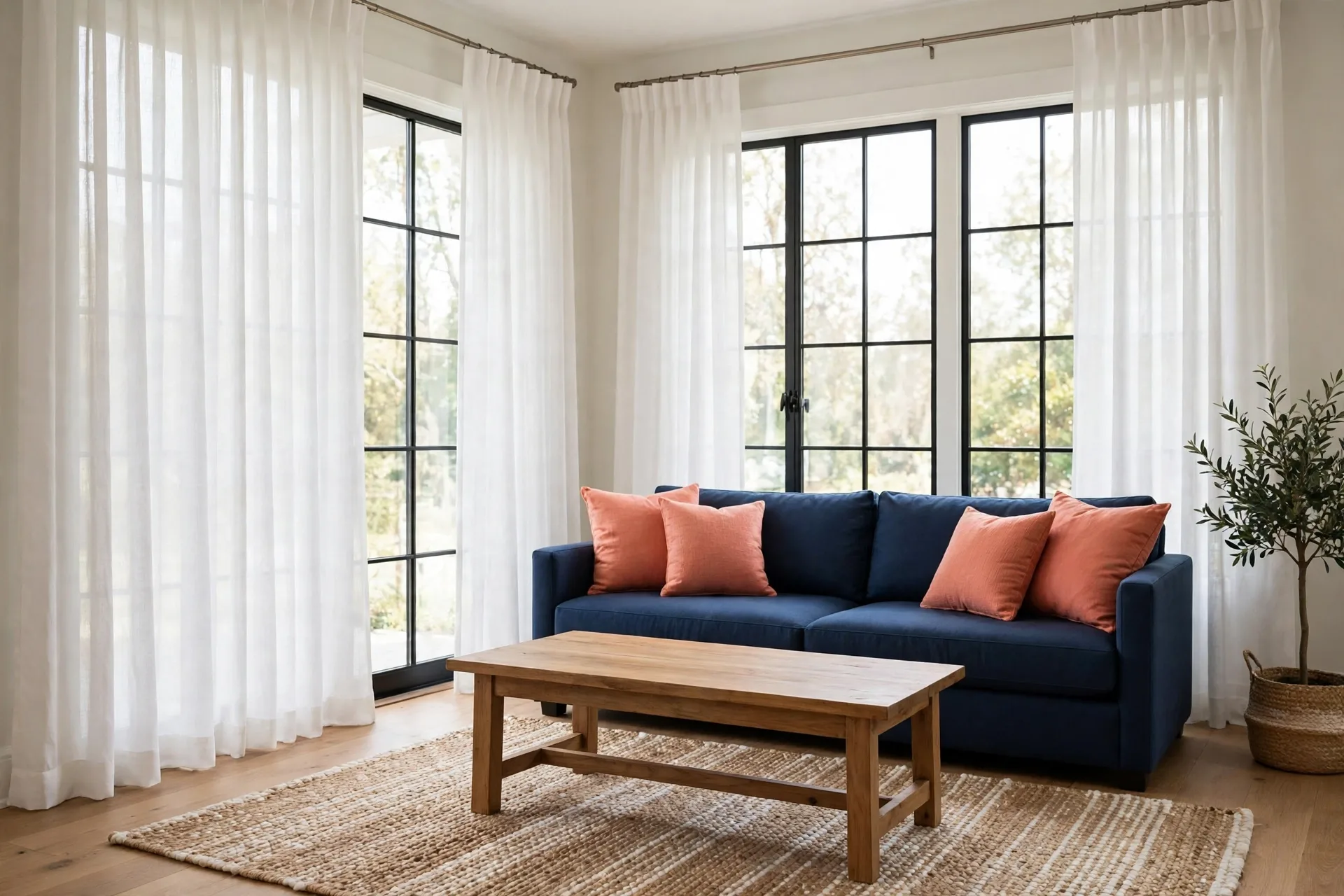
Best Curtains for Living Room
A living room asks one set of curtains to do several jobs at once: soften daylight, guard privacy, cut TV glare, and still look good. This guide matches picks to the job and to the direction each window faces.
A living room is the hardest working room in the house for curtains. It is bright in the morning, busy in the afternoon, and dark for films at night. It may face the street, hold the television, and open onto a patio at the same time. No single fabric wins every job, so this guide starts with what your room does and which way its windows face, then matches a pick to each answer.
Best curtains for living room: our picks
Insulated blackout suits TV rooms and sun-facing walls, linen suits bright everyday living rooms, and blackout with a linen look suits rooms that need darkness with texture. The picks below are grouped by job, not by brand rank. Each pick is a verified product with a direct Amazon link. Check the exact listing before buying, and confirm the exact variant, size, color, header, and care instructions on the listing, since brands such as Joydeco sell many variants. Performance claims in the cards are maker and listing descriptions, not verified test results. No sheer voile pick is listed, because the inner layer in this guide is a light-filtering linen-look panel (Pick 2 or Pick 5 type). For a true voile inner layer, see the sheer guide linked in the fabric table below.
As an Amazon Associate, we earn from qualifying purchases.
| Pick | Type | Best for | Lining |
|---|---|---|---|
| Joydeco Blackout Insulated Curtains | Insulated blackout | TV rooms and sun-facing walls | Insulated blackout build |
| Joydeco Linen Curtains | Linen blend, light-filtering | Bright, everyday living rooms | Light-filtering, no lining stated |
| H.VERSAILTEX Textured Blackout Curtains | Textured blackout, linen-style face | Everyday blackout for one window | Blackout build, lining not stated |
| Estelar Textiler Blackout Curtains | Blackout, ombre gradient | Several windows at once | Blackout, lining not stated |
| Lazzzy Farmhouse Linen Curtains | Linen blend, floral, light-filtering | Casual and rustic rooms | Light-filtering, lining not stated |
| MIULEE Blackout Linen Curtains | Faux linen face, blackout | Blackout with a linen look | Light-blocking build, lining not stated |
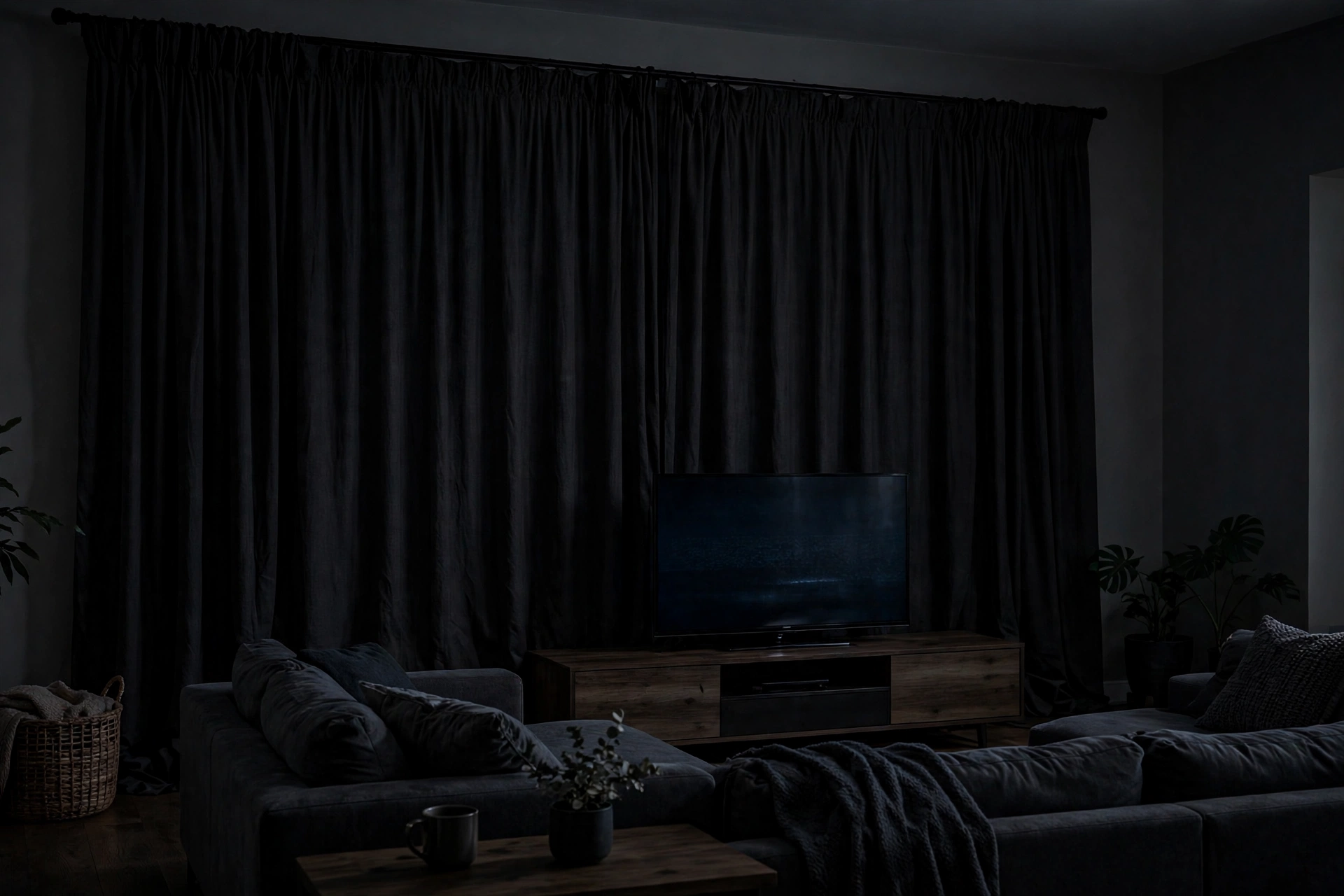
1. Joydeco Blackout Insulated Curtains: best for TV rooms and sun-facing walls
- Best for: living rooms used for films and television, and west-facing or south-facing windows where afternoon glare is the main complaint.
- Key features: Insulated blackout fabric that blocks most incoming daylight, as described on the listing; Solid, plain panels that suit modern and traditional rooms alike; A heavier drape that hangs in straight folds; Header not stated in this summary: check the listing before ordering.
- Pros: Strong glare control for television and film viewing; Helps keep strong sun and summer heat out of the room.
- Cons: Heavier fabric needs a sturdy rod and secure brackets; Too dark as a single layer for rooms that also need bright daylight.
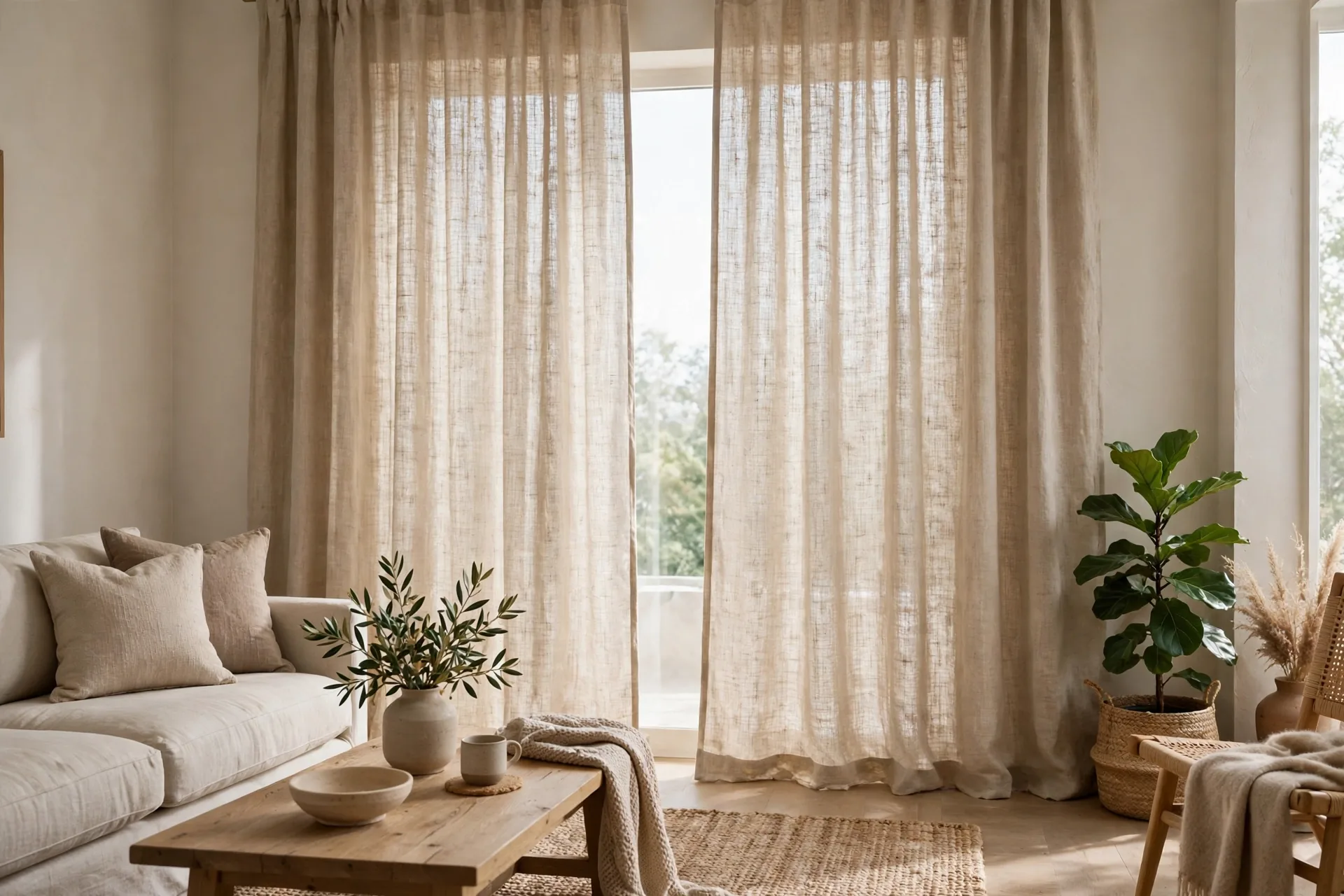
2. Joydeco Linen Curtains: best for bright, everyday living rooms
- Best for: rooms where daylight matters most, including north-facing and east-facing living rooms, and spaces used for reading, talking, and hosting.
- Key features: Linen blend fabric that filters daylight into a soft glow; Natural texture that looks relaxed rather than formal; Rod pocket and back tab heading; Long panels suited to floor-length hangs.
- Pros: Keeps the room bright while softening direct sun; Texture adds warmth to plain walls and neutral sofas.
- Cons: Not a privacy answer at night with the lights on; Will not control strong west sun on its own.
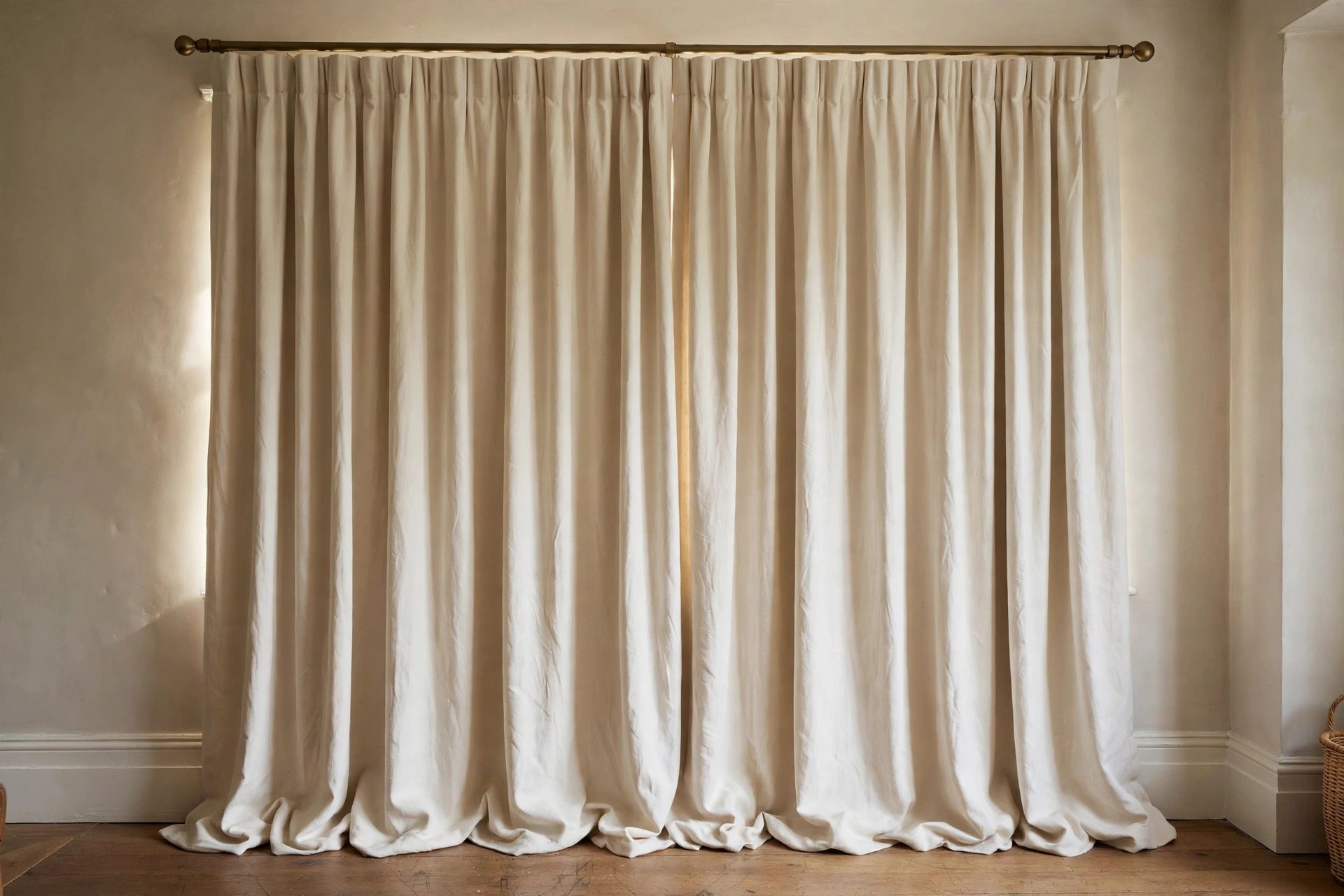
3. H.VERSAILTEX Textured Blackout Curtains: best everyday blackout for one window
- Best for: family living rooms and west-facing television rooms that need solid light control every day without a formal, heavy look. Pick 6 is the grommet linen-look alternative for media corners.
- Key features: Textured blackout fabric with a linen-style surface; Plain panels that work across many room styles; A structured drape that holds its shape; Grommet heading.
- Pros: Reliable light blocking for television, naps, and bright afternoons; Texture keeps blackout panels from looking flat or plain.
- Cons: Heavier than light-filtering panels, so check rod strength; Less airy than linen for rooms that prize brightness above all.
4. Estelar Textiler Blackout Curtains: best everyday blackout for several windows
- Best for: buyers who need to cover several windows at once, including west-facing rooms, and want a simpler blackout panel. No price is stated here, so compare the listing price before you buy.
- Key features: Blackout panels in a gray and grayish-white ombre gradient; Lighter weight than heavier blackout drapes; Simple styling that blends with most decor; Header not stated in this summary: check the listing before ordering.
- Pros: Solid glare and light control, as described on the listing; Practical for covering wide or multiple windows.
- Cons: Fabric feels thinner than heavier blackout options; May need a liner or a second layer for full darkness.
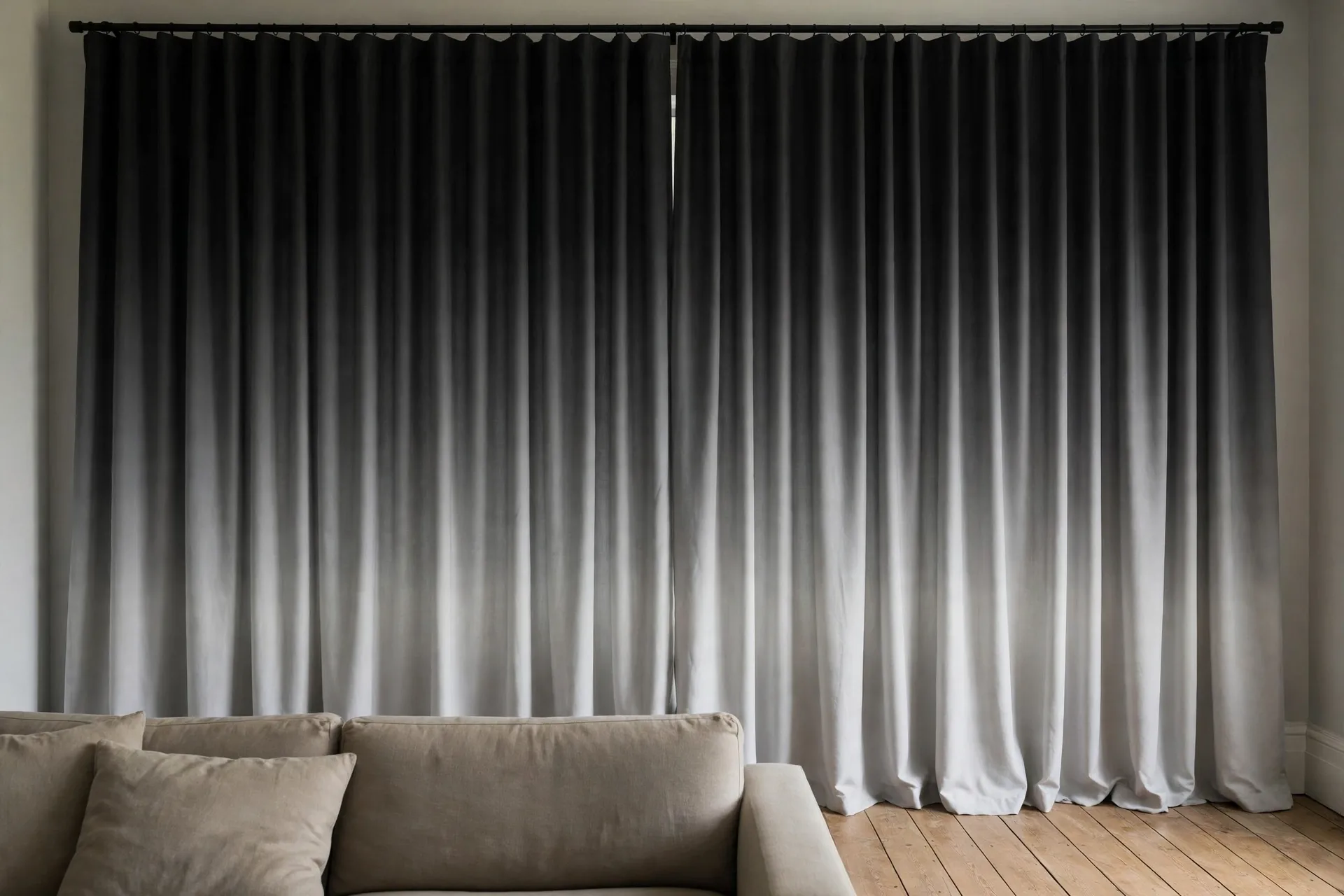
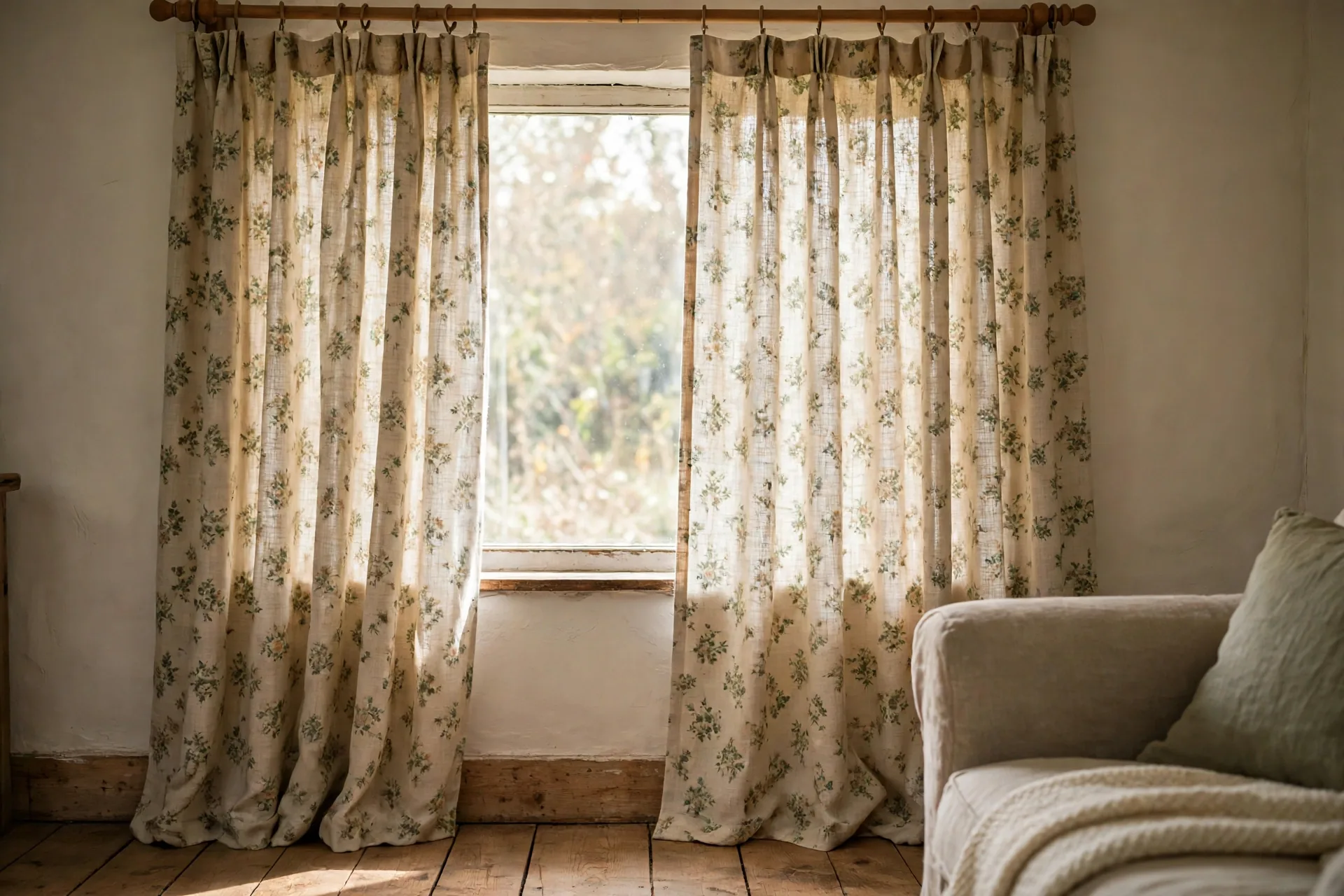
5. Lazzzy Farmhouse Linen Curtains: best for casual and rustic rooms
- Best for: farmhouse, country, and relaxed living rooms, including north-facing and east-facing rooms, where the curtain should add pattern and warmth, not just control light.
- Key features: Linen blend fabric with a soft floral pattern; Light-filtering weave for gentle daylight; Casual drape that suits relaxed rooms; Header not stated in this summary: check the listing before ordering.
- Pros: Adds character to neutral rooms without a full redecoration; Soft daylight suits reading, hosting, and daytime use.
- Cons: Pattern limits how easily it moves to a different room scheme; Not suited to rooms that need strong glare or night privacy.
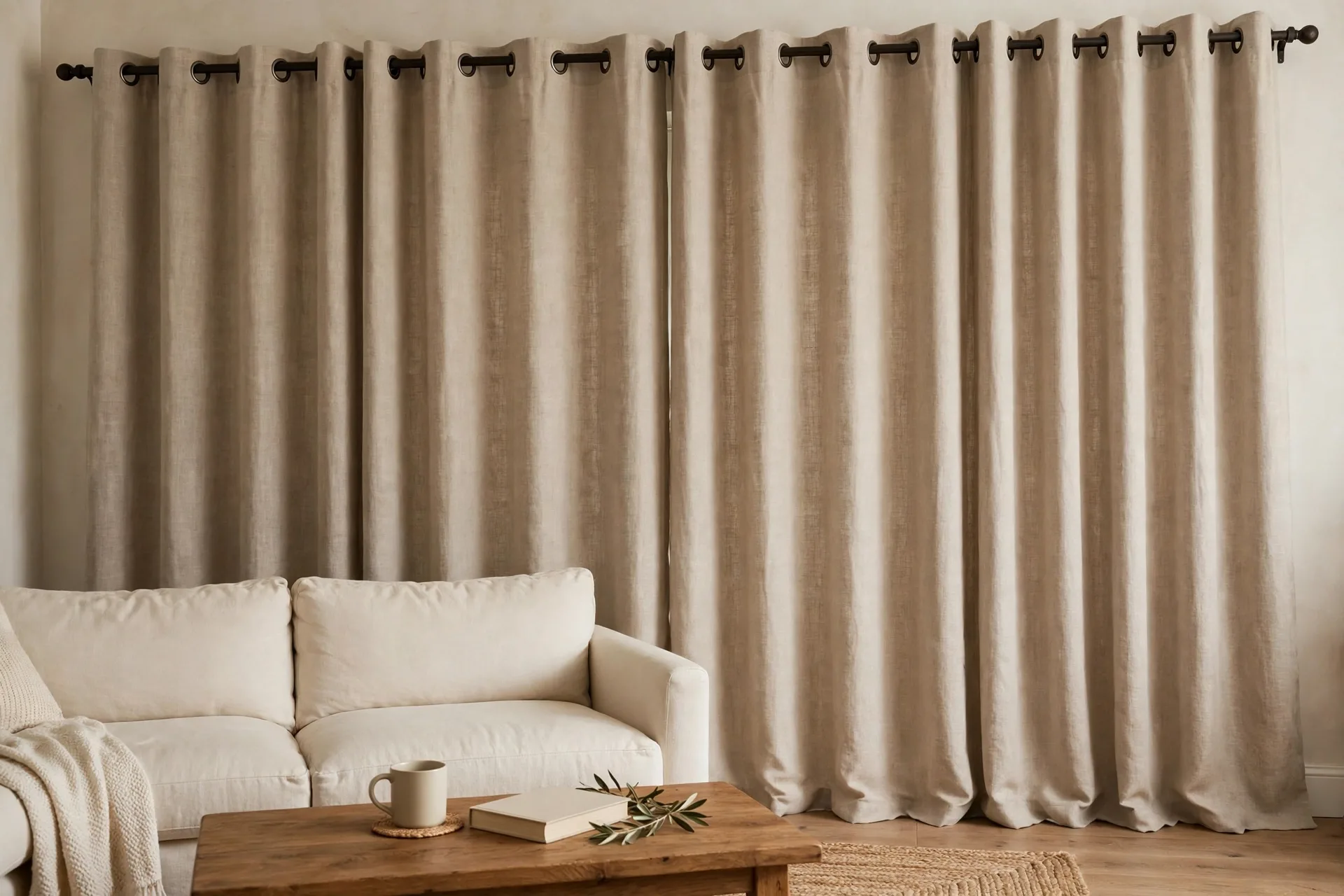
6. MIULEE Blackout Linen Curtains: best blackout with a linen look
- Best for: buyers who want blackout performance but dislike the flat, plain face of most blackout panels, in west-facing rooms and media corners.
- Key features: Faux linen face fabric over a light-blocking construction; Grommet top for smooth sliding on a rod; Plain, neutral panels for living rooms and media corners.
- Pros: Strong light control with a softer, textured look; Grommets make daily opening and closing easy.
- Cons: Grommet style suits casual and modern rooms more than formal ones; Needs a rod with enough clearance for the rings to slide freely.
Start with the job, then the direction
The best curtains for a living room are the ones that fit the room's main job first and its window direction second. A street-facing room needs daytime privacy. A TV room needs glare control in the afternoon. A sun-facing room needs fabric that softens strong light without turning the room dark at noon. A north-facing room mainly needs help keeping what little light it gets.
That order matters because two rooms with the same sofa and the same window size can need opposite curtains. Name the job, check the direction, and the fabric choice mostly makes itself.
Pick by window direction: north, east, south, and west
Window direction sets how much direct sun a room gets and when. Use it to narrow the fabric before you shop for color or style. Directions below are for the Northern Hemisphere. In the Southern Hemisphere, north and south reverse: north windows get the longest direct sun, and south windows get soft light.
North-facing windows: keep the light you have. In the Northern Hemisphere, north light is soft and steady, with little direct sun through the day. Sheer or light-filtering panels suit it best, because they add daytime privacy and finish without dimming a room that is already short on sun. A heavy blackout panel here is usually wasted unless the room also serves as a film room at night, and in that case a layered setup beats a single heavy curtain.
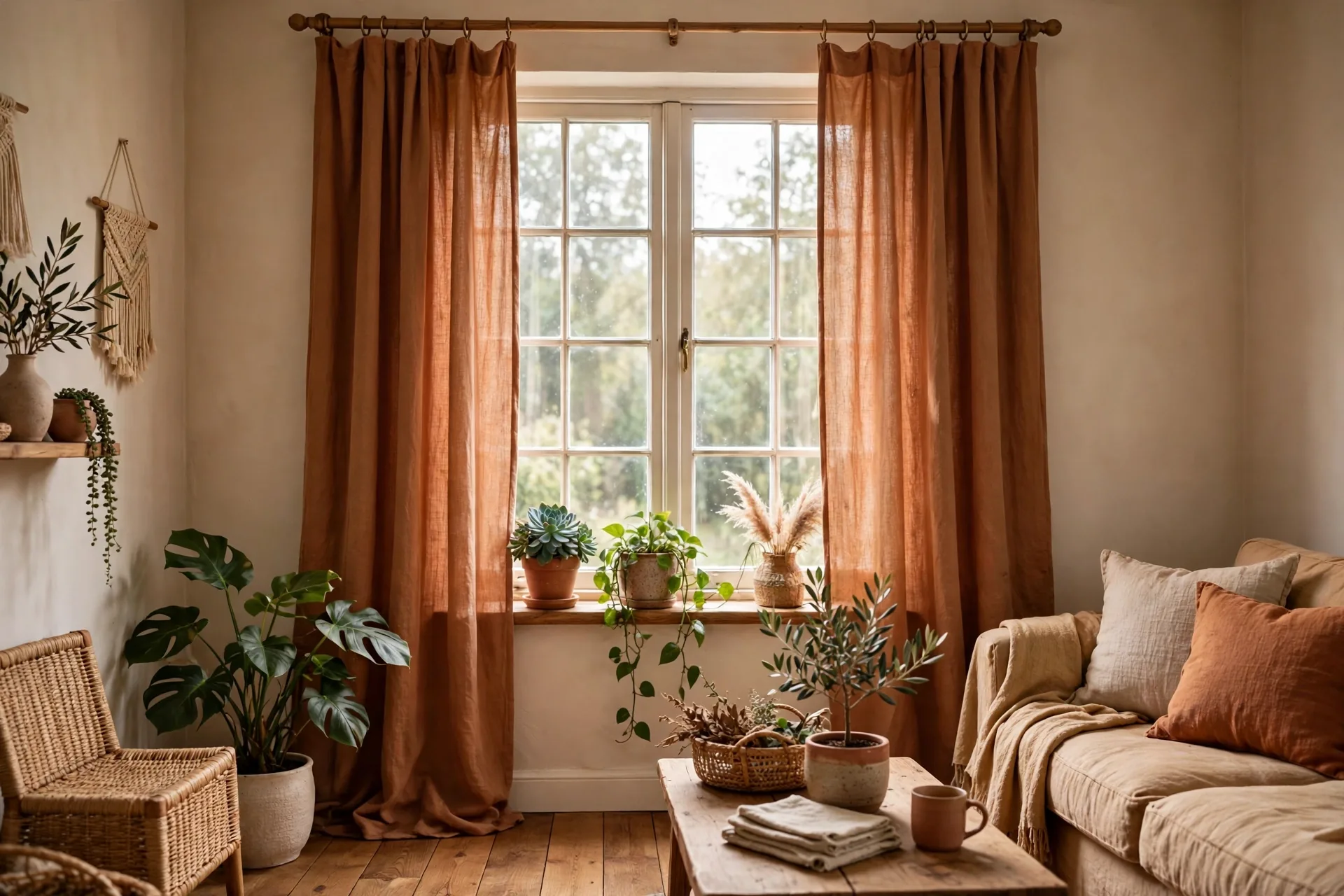
East-facing windows: soften the morning, then relax. East windows catch strong morning sun that fades by midday. Light-filtering linen or a semi-sheer panel takes the edge off the early glare while keeping the room bright for the rest of the day. If the television sits opposite an east window, add a darker outer layer you can close for morning viewing and open again by lunch.
South-facing windows: filter all day, protect the furniture. In the Northern Hemisphere, south windows get the longest stretch of direct sun. Light-filtering fabric with a lining, or a sheer layer paired with a heavier drape, softens that light through the day and helps shield floors and fabric from harsh sun. This is the direction where a single thin sheer is most likely to disappoint, since it leaves both glare and heat largely untouched.
West-facing windows: plan for the afternoon. West sun arrives late, low, and hard, right when many people sit down to watch television or read. This is the toughest direction for a living room. Room-darkening or blackout outer panels, layered over sheers, give you bright daylight in the morning and real glare control in the afternoon. If you can only upgrade one window in the living room, upgrade the west one first.
Rooms with windows on two sides: treat each wall by its own direction. A south-plus-west room, for example, can carry light-filtering panels on the south wall and a layered setup on the west wall, in the same face fabric and color, with different linings: a light-filtering lining on the south wall and a blackout lining on the west wall, so the look matches while the function differs, and the room still looks like one space.
Direction to pick: bright north-facing and east-facing rooms point to Pick 2. South-facing rooms point to Pick 2 or Pick 5 with a lining. West-facing and television rooms point to Pick 1 or Pick 3. Several windows point to Pick 4. Textured blackout points to Pick 6. Casual rooms point to Pick 5.
Living room curtain fabrics at a glance
Use this table to compare fabrics before you fall for a color. Light control runs from sheer, which filters light, to blackout, which blocks most of it. Privacy follows the same scale during the day, but no sheer or light-filtering fabric gives full privacy at night with the lights on.
| Fabric | Light control | Daytime privacy | Best living room job |
|---|---|---|---|
| Sheer voile | Filters, stays bright | Low, shapes show | Layering, bright rooms, north windows |
| Semi-sheer linen-look | Softens sun | Moderate, details blur | Everyday living, east windows |
| Linen and linen blends | Filters with texture | Moderate | Hosting, reading rooms, relaxed style |
| Light-filtering cotton blends | Softens strong sun | Moderate to good | South windows, street-facing rooms |
| Room-darkening lined drapes | Cuts most glare | Good | TV rooms, west windows |
| Blackout fabric | Blocks most light | High | Films, media corners, harsh sun |
| Velvet | Cuts light, softens sound | Good | Formal rooms, high ceilings, echoey spaces |
A note on care: always follow the care label on the panel you buy. Lighter weaves and linen-look fabrics often need a gentle cycle or careful handling, while denser panels tend to hold their shape with less fuss. If easy washing matters to you, check that detail on the listing before you order, since it varies by product. For a closer look at each fabric family, see Best Sheer Curtains, Best Linen Curtains, Best Thermal Insulated Curtains, and Best Blackout Curtains. Velvet in the table is for formal rooms with high ceilings and echo: it cuts light and softens sound, but it is heavy and often needs dry cleaning, and it has no pick here, because formal-room velvet is bought by room rather than by a single living-room pick. For a formal room, choose a lined velvet panel and check the care label.
Header styles in brief
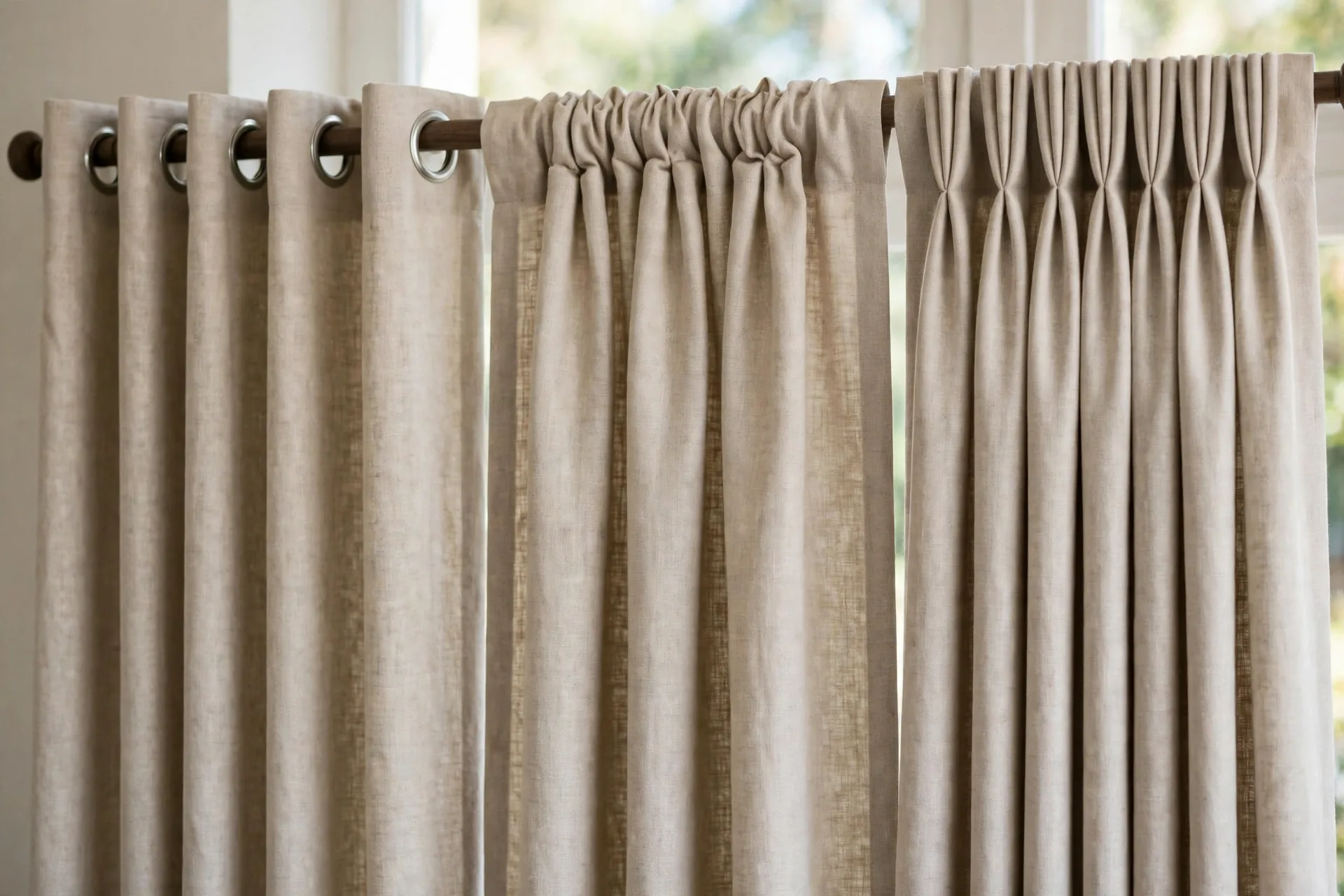
The header is how the curtain hangs from the rod, and it changes the whole look. Pinch pleat gives structured, tailored folds and suits traditional and transitional rooms. Ripple fold, also called S-fold, falls in smooth waves and suits modern and minimal rooms. Grommet tops slide easily and look casual and modern, which helps on windows opened daily. Rod pockets gather softly but can drag on wide spans, so they suit panels that mostly stay put. Back tabs hide the rod for a clean line and suit relaxed rooms where panels mostly stay in place, since they slide less freely than grommet. Pick the header for the room style and for how often the curtains will move.
Layering in brief
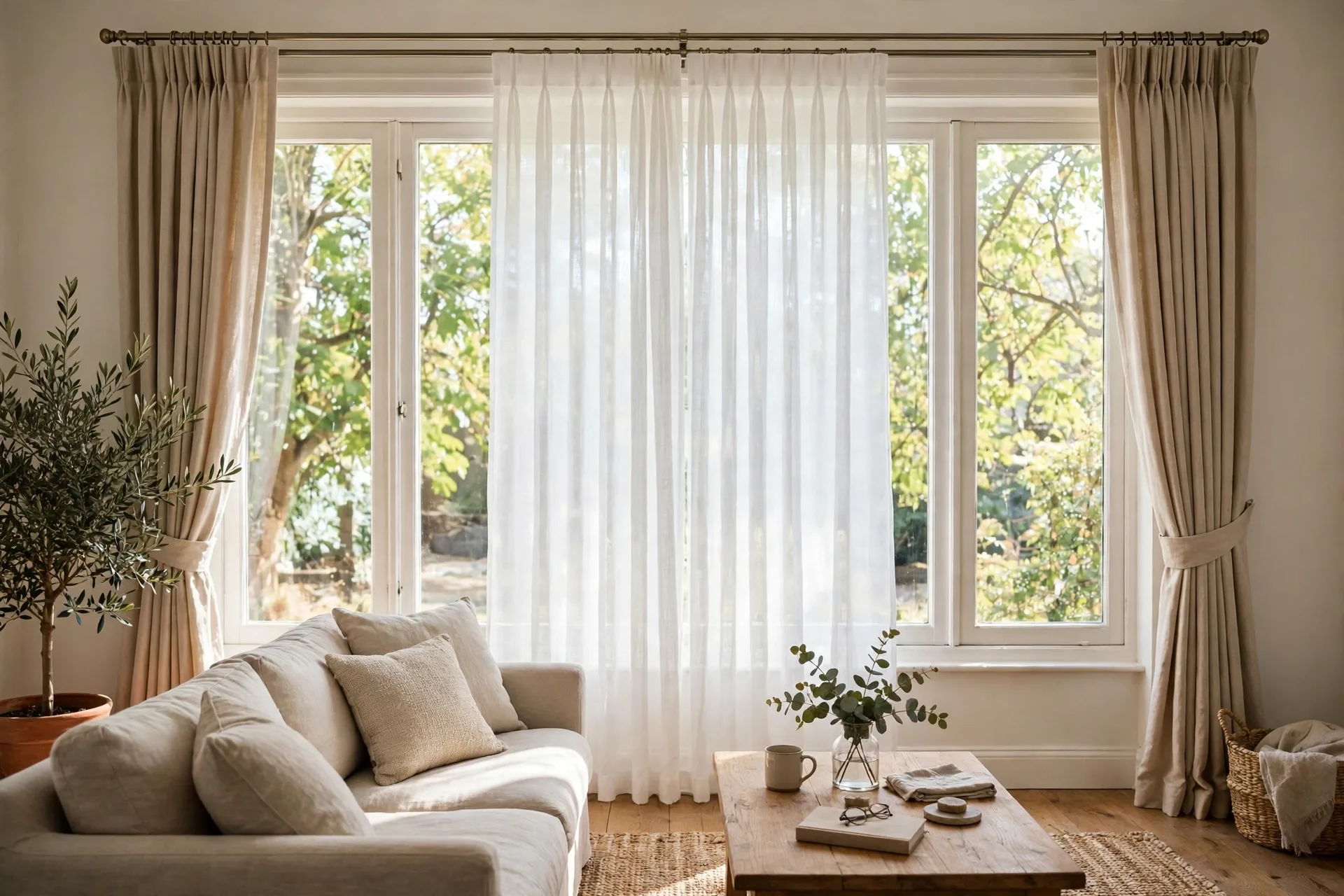
Layering means hanging two treatments on one window so the room works at every hour. The usual pair is a sheer or light-filtering inner panel for daytime softness plus a heavier outer drape for evening privacy and glare control. For a true voile inner layer, use the sheer guide linked in the fabric table above; the light-filtering linen-look picks in this guide (Pick 2 or Pick 5 type) are the denser alternative. A double rod or a double track lets each layer move on its own. During the day, open the outer drape and let the sheer filter the light. At night, or for a film, close the outer drape.
A TV glare plan that keeps the room bright
A TV glare plan starts with finding the real glare source, not with buying a darker curtain. Sit in your usual seat at the worst time of day, turn the television off, and look at the dark screen. Any window reflected there is a glare source, and the time matters, since a room fine at noon can be unwatchable at four in the afternoon when west sun comes in low.
Work through the fixes in this order.
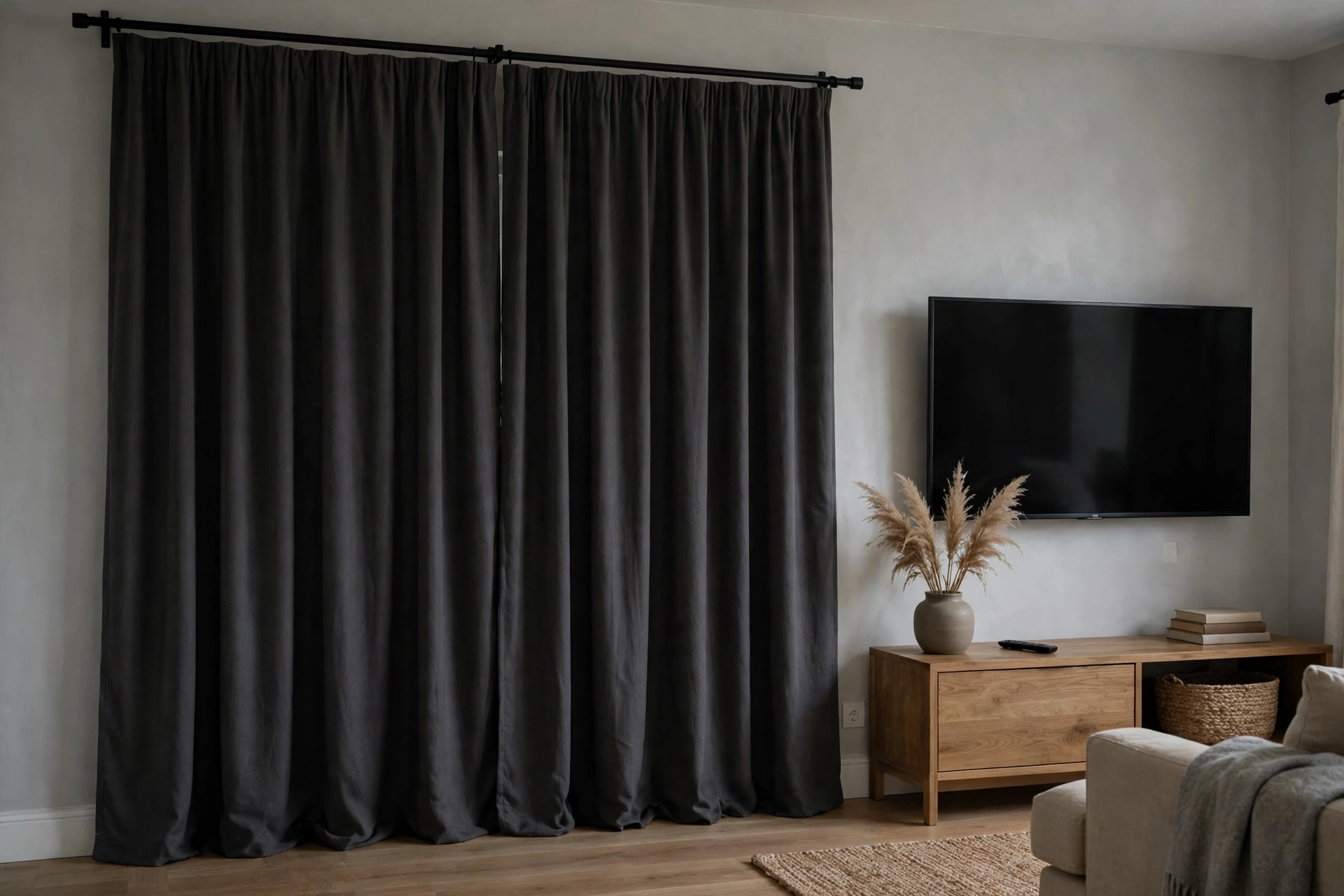
First, cover the problem window with a room-darkening or blackout outer layer, hung high and wide so light does not leak around the edges. Second, check the television position: a screen on a wall at a right angle to the window usually suffers less than a screen directly opposite the glass, and a small swivel or tilt change can move a reflection out of the seating area. Third, move lamps out of the reflection path and keep evening light soft and behind the screen rather than behind the seating area, so it does not reflect in the screen. Fourth, adjust the television brightness to match the room instead of forcing it to overpower an untreated window.
Keep the daytime layer in place. Sheers or light-filtering panels stay closed during the day for soft light and privacy, and the darker layer only closes for viewing. That way the room never has to choose between a bright living space and a watchable screen.
Large windows, bay windows, and sliding doors in brief
Large windows reward floor-length panels hung high and wide. Extend the rod well past the frame on both sides so the panels stack back onto the wall, not onto the glass, and the view stays open when the curtains are drawn back. Use two or more panels per window rather than one wide panel, since panels stack neatly and give the fullness that makes a big window look finished. For very wide spans, a ceiling track or a traversing track glides better than a long rod, which can sag under heavy fabric.
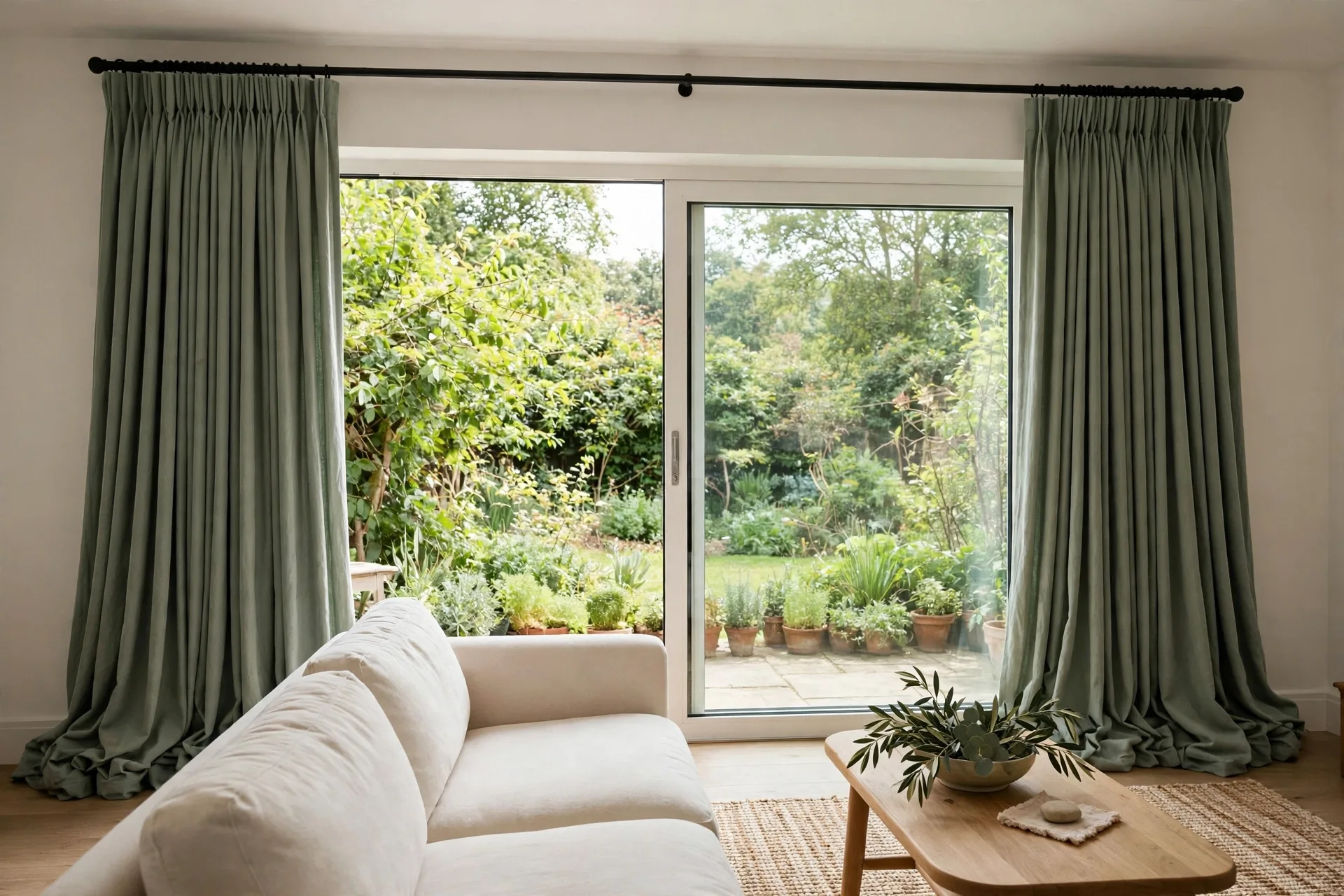
Bay windows need one rod per angled section, or a curved bay rod, so each panel moves cleanly without bunching at the corners. Corner windows work best with a continuous rod that wraps the corner, which looks like one planned treatment rather than two awkward halves. Sliding doors need panels that clear the door path: hang them high and wide enough to stack fully clear of the glass, and pick a header that slides smoothly, such as grommet or ripple fold.
How to choose in ten minutes
Work through these six steps and you will have a short list. One, name the room's main job: bright living, television, hosting, or privacy from the street. Two, note the window direction for each wall, using the direction section above. Three, pick the fabric weight that fits both answers, or pick a layered pair if the answers pull in opposite directions. Four, choose a header that suits the room style and how often the curtains will move.
Five, measure the width and the drop, then check the rod strength and the stacking space.
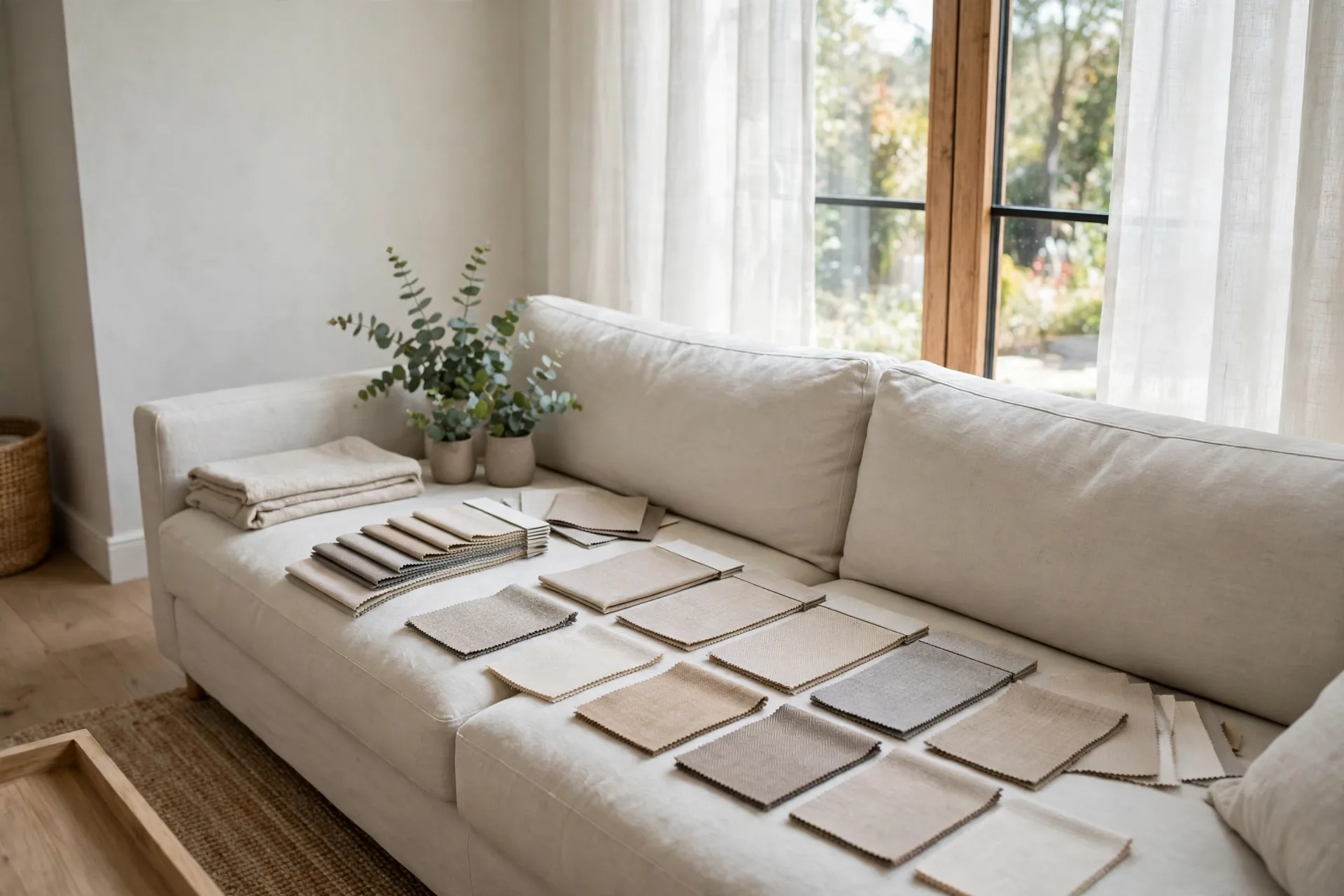
Six, confirm the panel count, since some listings sell a single panel and others sell a pair: count panels per window, not per room, and check the header style and care label on the exact listing.
Two pages carry the measuring and hanging detail in full: How to Measure for Curtains and How to Hang Curtains. Read those before ordering, since a good fabric in the wrong size still looks wrong. The main Best Window Curtains guide covers type, fabric, and room choices together.
Choosing a color for a living room
Start with the walls, not the curtain rail: curtains close to the wall color make a room feel calm and a little larger, while a clear contrast turns the window into a feature of the room.
A neutral base is the safest starting point, and white, ivory, beige, gray, and taupe all sit quietly beside most sofas and rugs. Use contrast when the room needs a focal point, for example a deep tone against pale walls, and keep the rest of the room calm so the window does not fight the furniture. When the room already has a strong color in the rug or the sofa, match the curtains to a quieter tone from that same scheme rather than adding a new strong color.
Style narrows the palette further. A modern room suits plain fabric in cool neutrals with a crisp header. A farmhouse room suits warm neutrals and linen texture with a soft check or a small floral used sparingly. A coastal room suits white, sand, and pale blue in light linen. A traditional room suits deeper tones, lined drapes, and a pinch pleat header. In every case, look at a swatch in the room itself in daylight and again at night, because a color that looks soft in a shop can read much darker beside a north window.
Choosing pattern or plain
Pattern earns its place when the room is otherwise plain, and solid fabric is the safer choice when the sofa, rug, or wallpaper already carries a strong pattern.
Scale matters as much as the pattern itself. A large print suits a large room and a wide window, where it has room to repeat, while a small print suits a small room and a narrow window, where a large print would be cut off awkwardly.
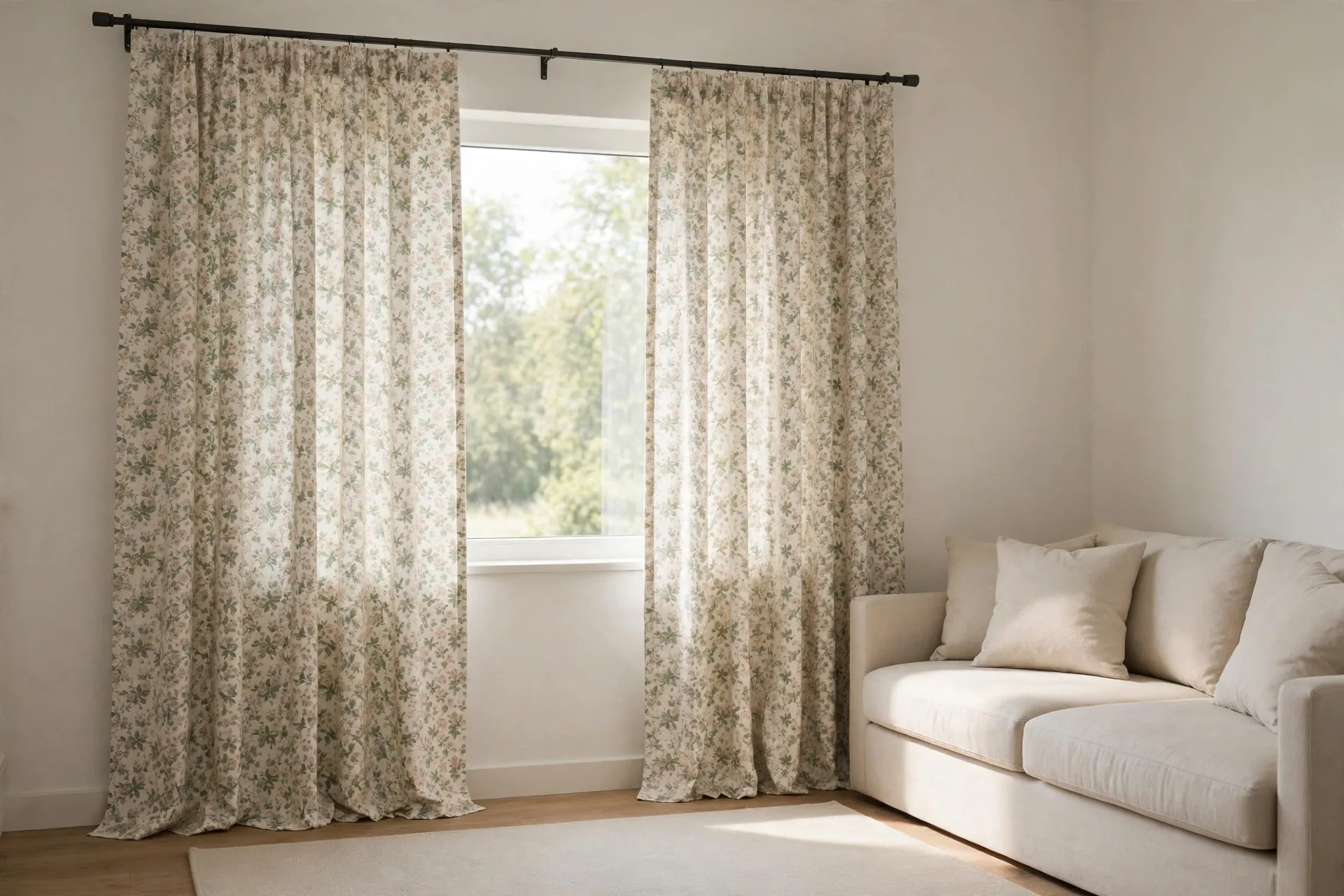
Keep to one patterned element in each view: if the curtains carry the pattern, keep cushions and throws plain, and if the rug carries the pattern, let the curtains stay plain.
To coordinate with what is already in the room, pick one color out of the sofa, rug, or wall art and repeat it in the curtain pattern, keeping the rest of the pattern neutral. Stripes are a useful middle ground, since a vertical stripe can make a window look taller, but a busy stripe beside a patterned rug will look restless. When in doubt, choose the solid version of a color you already love in the room.
How wide living room panels should be
Order about twice the rod width in total fabric for a standard gathered look, 1.5 times for a flatter look, and 2.5 times or more for sheers.
Total width means all panels added together, not one panel on its own. For a 48-inch rod, standard fullness means 96 inches of fabric in total, so two panels of about 48 inches each. To work out the panel count, divide the total fabric width by the width of one panel and round up to the next whole panel, then check whether the listing sells panels singly or as a pair. The Curtain Sizes and Lengths page carries the full width tables and worked examples for other rod widths.
Also allow for stack-back, which is the width the gathered panels take up when they are open. The rod must extend past the frame on each side by at least that stack-back width, or the open panels will sit over the glass and narrow the view.
Living room curtain lengths and finishes
Most living rooms suit floor-length panels, and the finish is simply a name for where the hem lands.
A float finish sits about half an inch above the floor, which suits busy rooms, pets, and panels opened daily, since the hem stays clear of dust and feet. A kiss finish just touches the floor with no gap, which gives the tidiest tailored look but needs a fairly level floor. A break finish carries 1 to 2 inches of extra fabric, so the hem bends slightly at the floor, which looks relaxed and forgives a floor that is not perfectly level.
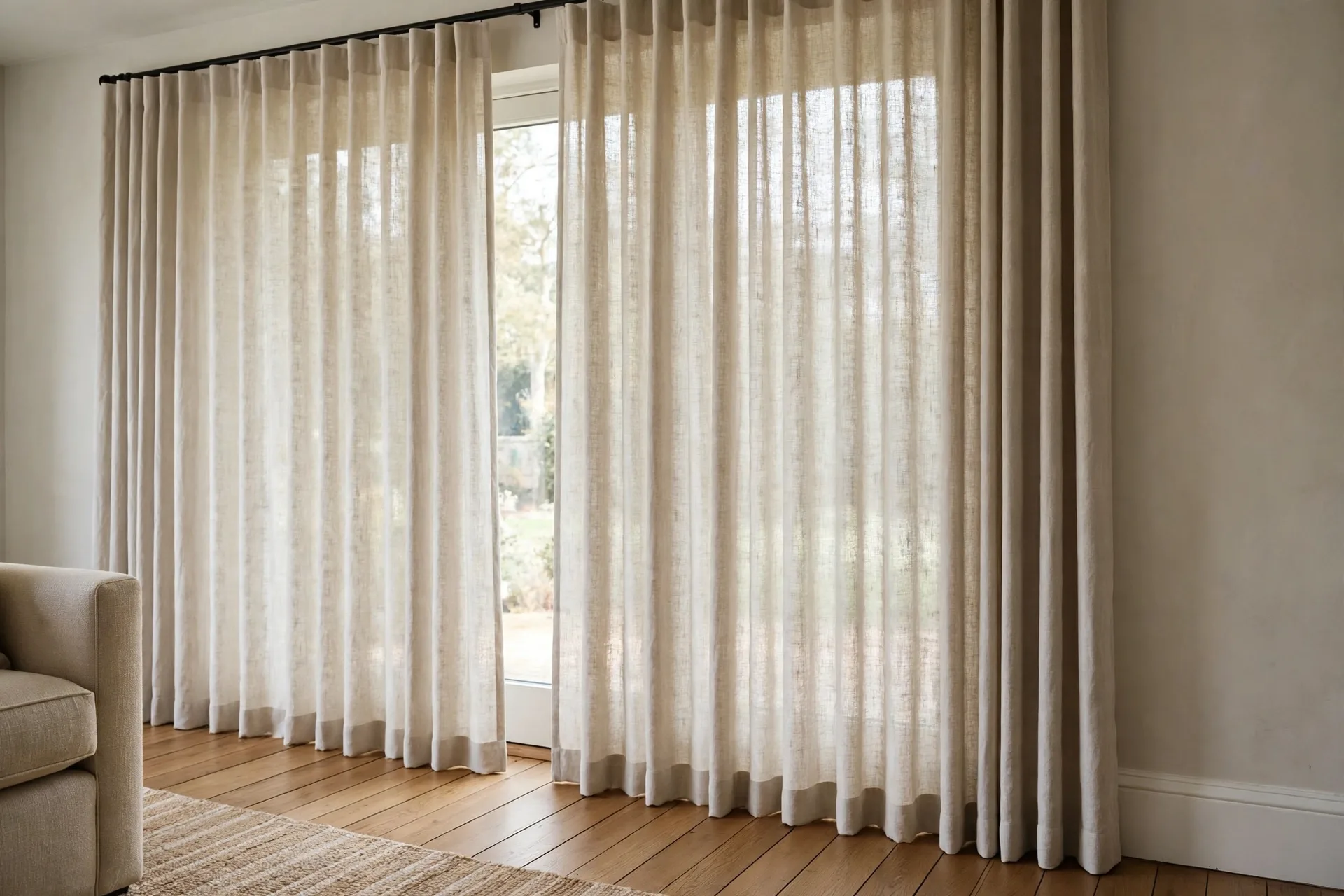
A puddle finish pools several inches of fabric on the floor, which suits formal rooms where panels stay closed and needs more upkeep.
Measure from the rod to the hem point, not from the top of the window, because a rod hung high needs a longer panel than the same window with a rod hung low. Ready-made lengths are commonly 63, 84, 96, 108, and 120 inches, so match the measured drop to the nearest length that gives the finish you want, and hem down where the next length up is the only fit.
Rods and hardware for a living room
Choose the rod for the weight it must carry and for how often the curtains will move, not for looks alone.
A standard rod suits a single layer on a normal window. A wrap-around rod, also called a return rod, brings the panel ends back to the wall, which closes the side gaps that let light leak around a blackout panel. A double rod carries two layers, such as a sheer and a blackout drape, each moving on its own rod, and the two rods need enough space between them for both layers to slide without catching. A ceiling track or a traversing track suits very wide spans, bay windows, and windows where panels move daily, since a long rod can sag under heavy fabric where a track glides.
Match the finish to the metals already in the room, such as black, nickel, brass, or wood, rather than mixing several finishes at one window. For heavy blackout or lined panels, use sturdy brackets fixed into solid material, with a center support on long spans, and check the rod for sag before the panels go up, since a rod that bends under load will drag and wear.
Thermal lining and warmth in a living room
A thermal lining slows heat moving through the window, so the room loses less warmth in winter and gains less heat in summer, but it does not seal a drafty window on its own.
The lining works with the still air trapped between the panel and the glass, so a floor-length panel hung close to the wall, with the sides and the top covered as far as possible, does more than a short panel on the same window.
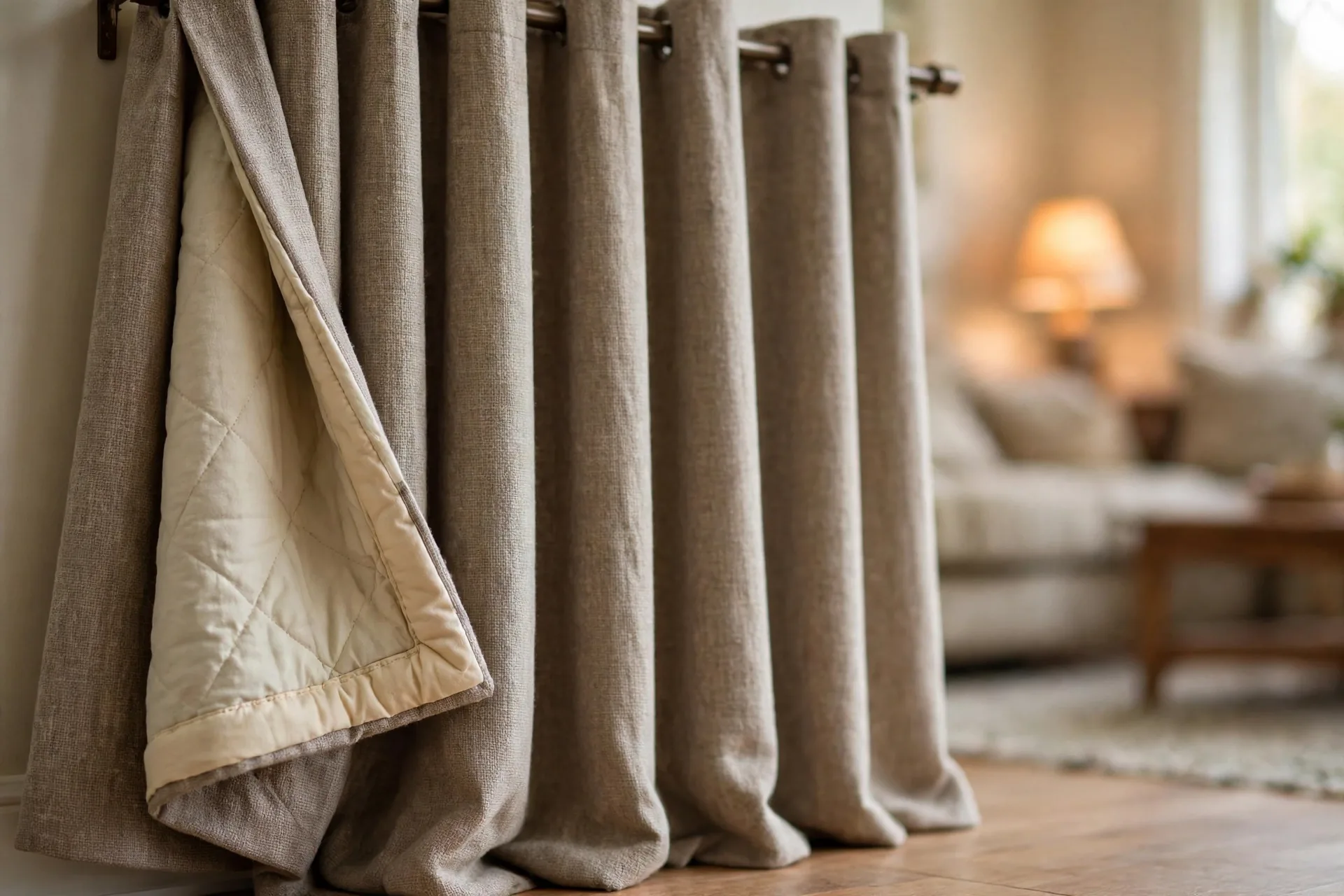
In winter, closing the panels at dusk keeps the warmth built up during the day inside for longer, and opening them on a sunny morning lets the sun warm the room again. In summer, closing them before the sun hits the glass cuts the heat coming in, and the habit of opening and closing through the day is set out in the energy guidance on window coverings from the U.S. Department of Energy.
Insulation and blackout are different jobs, and a panel can do one without the other. Blackout blocks light, while thermal lining slows heat, so check the listing for which lining is actually fitted rather than assuming a dark panel is also a warm one. Where a window is genuinely drafty, sealing the gaps around the frame comes first, and the curtain is the second step, not the fix on its own.
Sun and UV protection for a living room
Sunlight fades fabric, floors, and furniture near a window over time, and a lined panel slows that fading far better than a thin sheer, though no curtain stops it completely.
Some panels and linings are made with UV protection in mind, so check the listing description for UV wording where sun damage is the main worry, and treat a panel without that wording as sun-filtering rather than sun-blocking. Light-filtering and UV protection are not the same thing: a light-filtering panel softens visible light and glare, but that alone does not mean it blocks the rays that fade fabric. The practical steps are a denser weave, a lining, and closing the panels during the strongest sun, with south-facing and west-facing windows needing the most care.
Sound and echo in a living room
Heavy, full curtains soften echo in a hard-floored living room, but they do not block outside noise.
Velvet, heavy lined drapes, and panels hung with generous fullness help most, because weight and folds break up sound bouncing off bare walls and floors, while a thin sheer does almost nothing for echo. Treat this as a secondary benefit, not the reason to buy: choose the fabric for light and privacy first, and let the softer sound be a bonus.
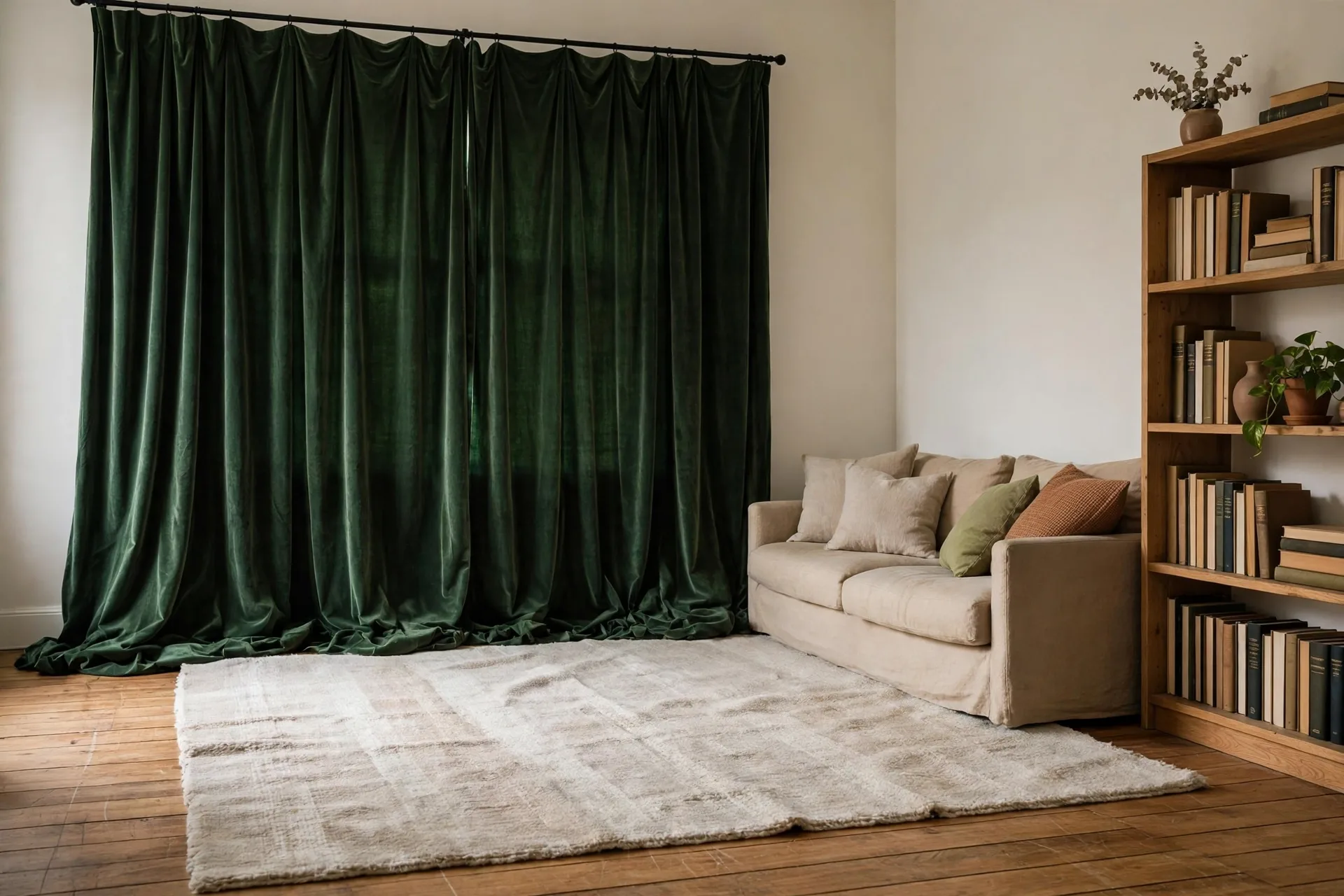
For a room that still echoes, a rug, soft seating, and full-length panels together do more than any one of them on its own.
Room-darkening or blackout for a living room
Room-darkening cuts most light and glare but still lets a soft glow through, while blackout blocks most light when the panel is closed and hung with overlap at the sides, top, and middle.
What room-darkening lets through is that glow itself, plus light slipping around the edges, over the top, and through the center join, so a room-darkening panel can still look bright on a sunny afternoon even when it is closed. Room-darkening is often enough for daytime television, where glare is the problem rather than darkness, and for rooms that need to stay usable during the day. Only blackout will do for film nights, for sleep during daylight, for streetlight shining straight into the room at night, and for low west sun hitting the screen directly, where any glow left through is enough to spoil the picture.
Washing and caring for living room curtains
Care differs by fabric, so check the label on the exact panel before washing, and use the care symbols on that label to settle wash, dry, and iron questions, as shown in the care symbols explained by GINETEX under the international ISO 3758 care labeling standard.
Linen wrinkles and softens with use, so steam it while it is still slightly damp and expect creases to be part of the look rather than a fault.
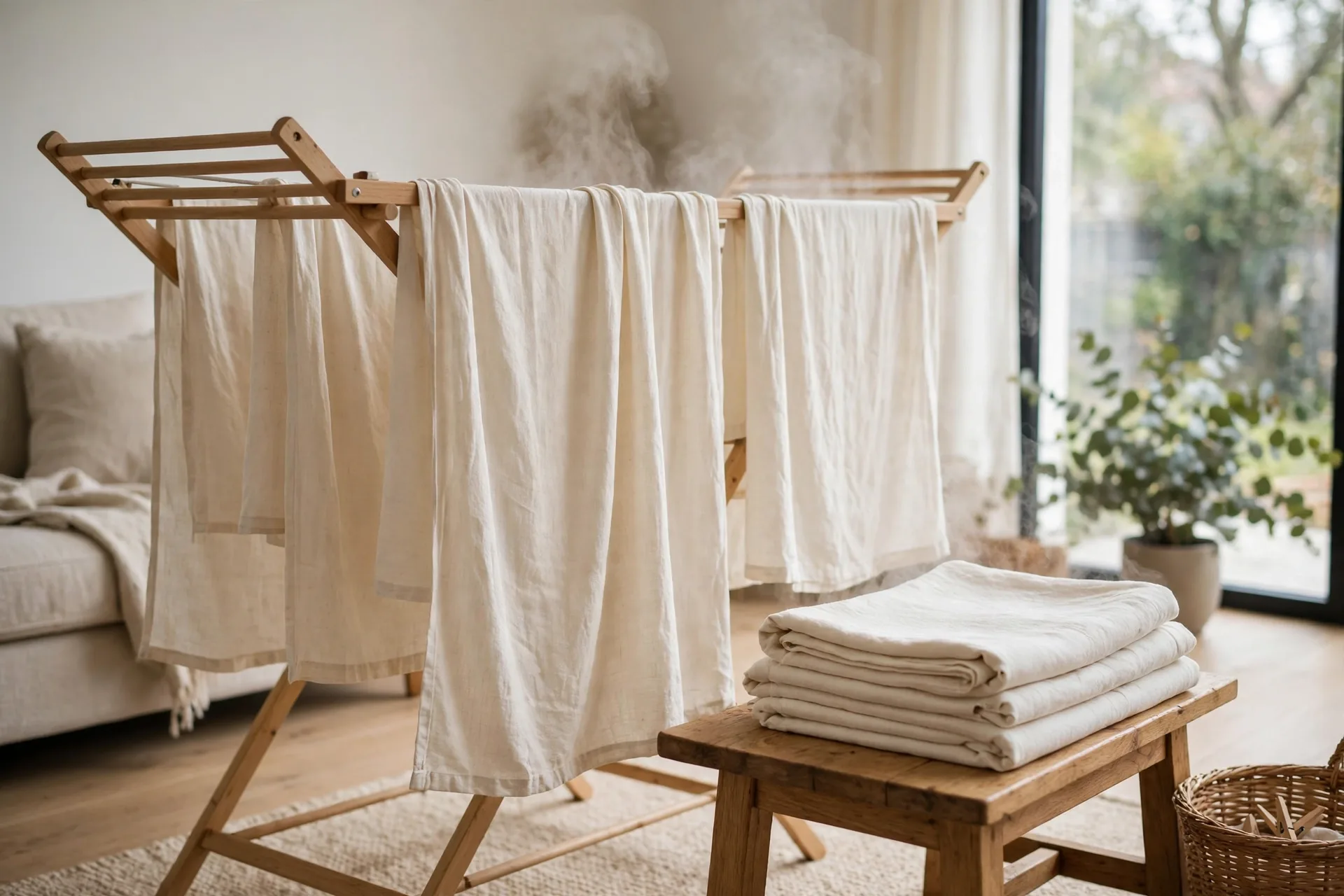
Cotton blends are usually the easiest to wash at home, on a gentle cool cycle where the label allows it, but check the label first, since a lining can change the care. Velvet is often dry-clean only, so brush or vacuum it between cleans and keep it away from high heat. Blackout backing needs gentle handling too, since a coating or foam backing can crack or peel with heat, so wash cool and gentle where the label allows it and never force a high-heat tumble dry.
One label worth knowing is the OEKO-TEX STANDARD 100 label, which tests textiles for harmful substances. Curtains sit in Product Class 4 of that system, the class for home textiles and decoration materials, so the label tells you about the textile itself rather than about light control or warmth.
Curtains, blinds, valances, and tiebacks
Blinds, valances, and tiebacks sit with curtains rather than instead of them, and each one solves a different part of the window.
A blind close to the glass handles daytime privacy and glare in small steps, while the curtain on the room side adds warmth, softness, and evening darkness, so the pair together covers hours of the day that neither covers well alone. A valance is a short treatment across the top of the window that hides the rod and the header, which suits formal and traditional rooms, but it trims the visible window height, so it suits tall windows better than short ones. Tiebacks hold open panels to the sides, which shows off the window, keeps fabric clear of furniture and radiators, and suits rooms where the panels stay open for most of the day.
Small windows, pets, children, and renters
Small windows, pets, children, and rented walls each change the choice, but none of them needs a different fabric family, only a different length, hang, or mount.
A small window with a radiator, seat, or desk below it is the one living-room case where a short sill or apron length beats floor length, since a floor panel there would hang over the obstacle and look heavy.
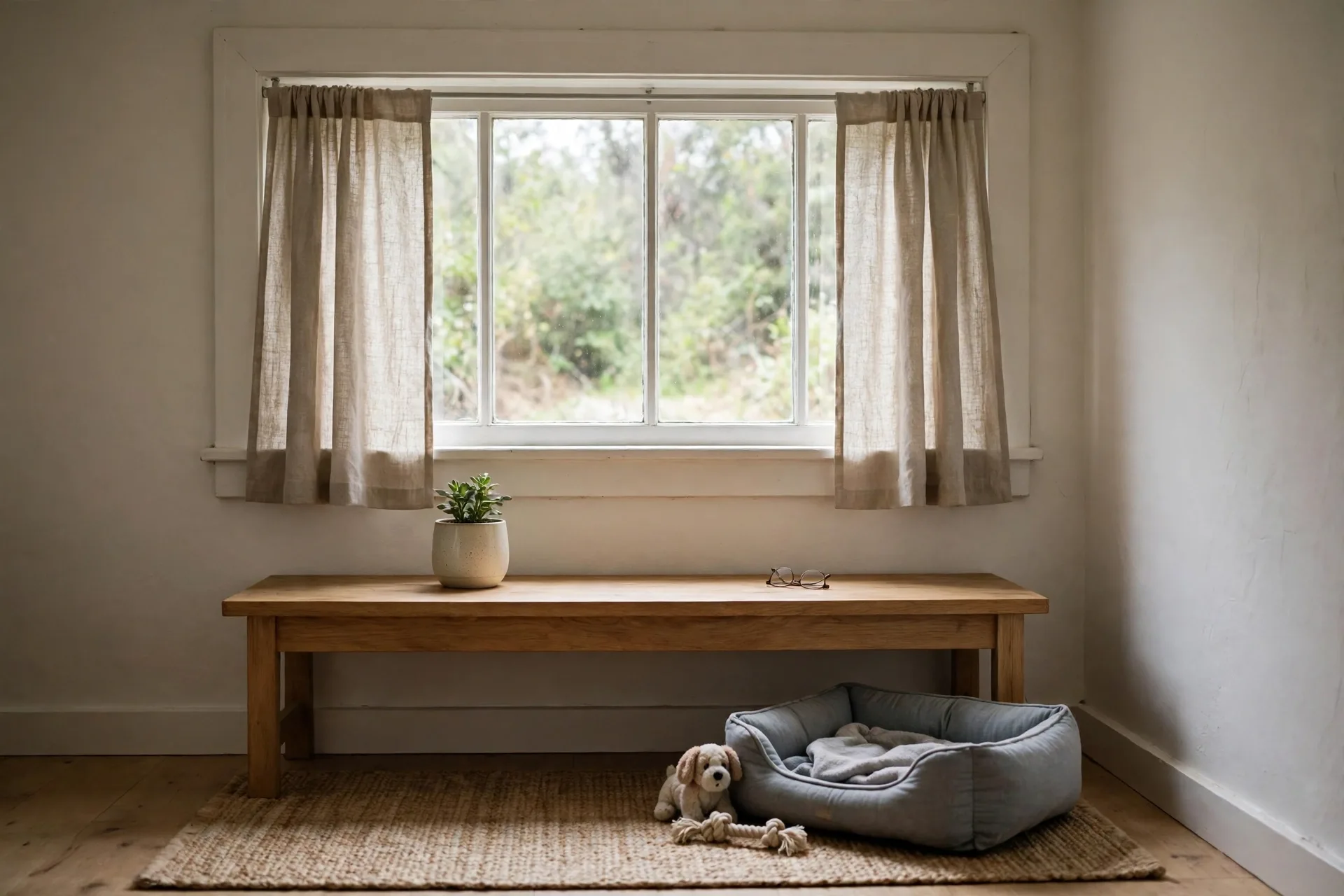
For pets, a float finish keeps the hem off the floor and away from claws and dirt, a washable fabric matters more than a delicate one, and a puddle finish is best avoided where paws pass through. For children, choose cordless operation where you can, and keep cots, beds, and climbable furniture away from the window and its cords, following the safety guidance on window covering cords from the U.S. Consumer Product Safety Commission.
For rented walls, a tension rod inside the frame suits light panels, and adhesive mounts suit light panels within the weight guidance for the mount, but neither suits heavy blackout or lined panels, which need drilled brackets into solid material. Check the mounting rules for the home first, and plan the panel weight around the mount that is actually allowed.
What drives the cost of living room curtains
What raises the cost of a living-room treatment is rarely the face fabric alone, since lining, header, and made-to-measure sizing are the usual drivers.
A lining adds material and work, and a blackout or thermal lining adds more than a plain lining. A pinch pleat or ripple header takes more making than a rod pocket or a grommet top, and a layered pair is two treatments, not one, so it carries two sets of fabric and hardware. Made-to-measure sizing for a wide, bay, or very tall window costs more than a ready-made standard size, while a standard size in a standard room keeps the treatment simple. Spend first on the worst window, usually the west-facing or television window, and repeat the same fabric and header on the easier windows, varying only the lining where the job differs.
Mistakes that make living room curtains look wrong
Most living-room curtain mistakes are sizing and hanging mistakes, not fabric mistakes.
A rod hung too low makes even a long panel look short, so hang it high and let the measured drop decide the length. Panels that are too narrow look flat when closed, so order the fullness the window needs rather than one thin panel per side. A single panel on a wide window leaves a gap in the middle, so count panels per window, not per room.
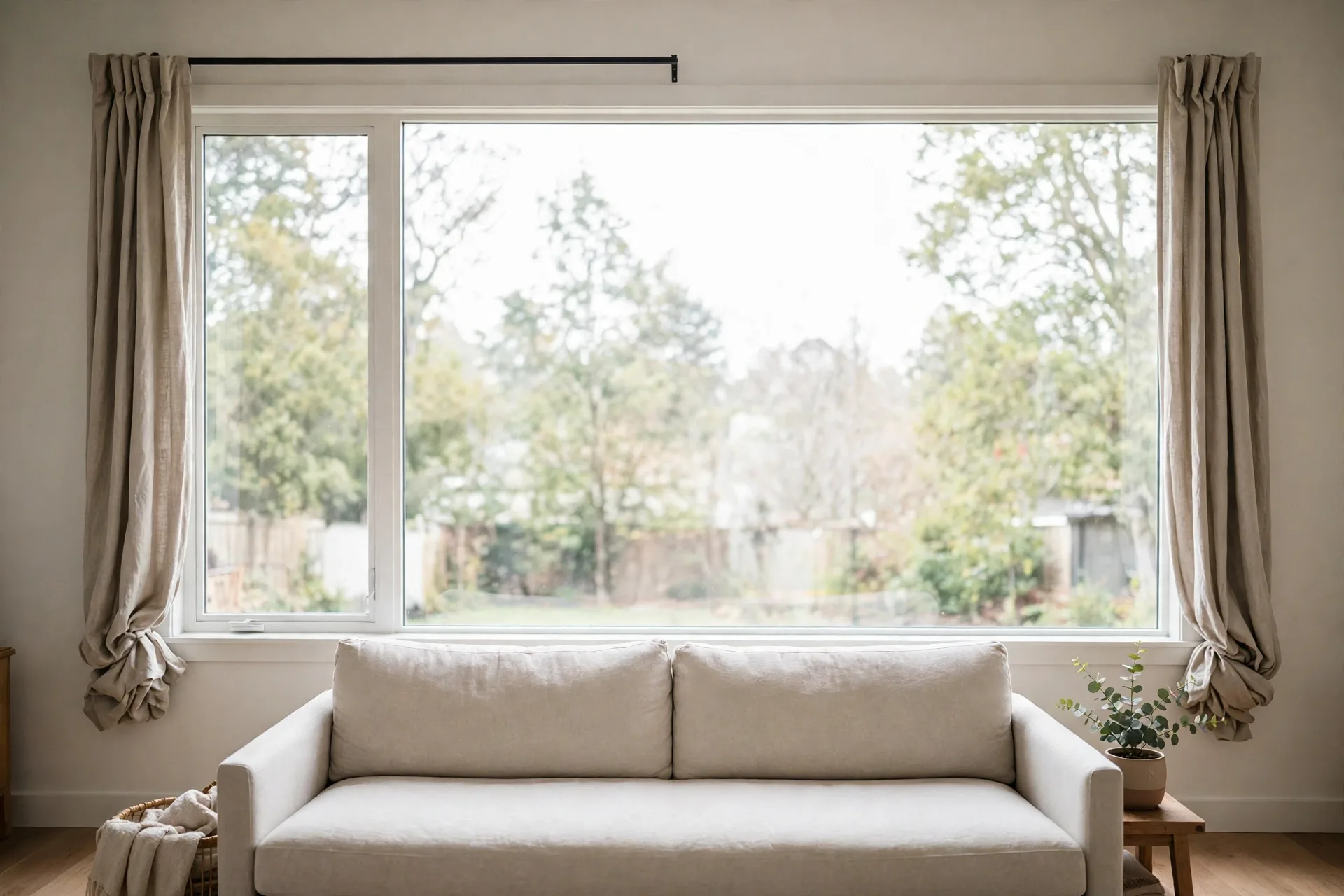
A heavy panel on a weak rod sags and drags, so match brackets and rod strength to the panel weight. A color chosen without a swatch can read wrong in the room light, so check the swatch in daylight and at night. A puddle finish in a walkway trips feet and gathers dirt, so keep puddles for formal rooms where panels stay closed, and check the stack-back, since open panels that cover the glass narrow the view the curtains were bought to frame.
Stationary panels that stay put
Stationary panels are panels that frame a window for looks and are never drawn closed, and they suit windows that already have a blind or a sheer doing the light and privacy work.
Use narrow panels on each side of the frame, floor length, with enough fullness to look intentional rather than flat, and let them cover the frame edges so the window looks dressed even though the panels never move. Do not rely on stationary panels where evening privacy or darkness is needed, since an open panel gives neither, and pair them with a closable layer for those hours. They also suit windows that are rarely opened, such as a high window or a window behind furniture, where a working panel would be hard to reach.
Frequently asked questions about living room curtains
Are blackout curtains too heavy for a living room?
No, not on their own. Blackout fabric suits TV rooms, west-facing windows, and film nights. The trick is to pair it with a sheer or light-filtering daytime layer, so the room stays bright when the dark panels are open and only goes dark when you want it to.
Should living room curtains be sheer or blackout?
Neither answer fits every room. Sheers suit bright rooms, north windows, and layering. Blackout suits television, harsh sun, and night privacy. Most living rooms land in the middle: a light-filtering panel for the day, with a darker layer for evenings.
What curtains work best for a west-facing living room?
West rooms need the strongest afternoon plan. A layered setup works best: sheers or light-filtering panels for morning light, plus room-darkening or blackout outer panels for the low afternoon sun. Hang the rod high and wide so light does not leak around the edges.
Do living room curtains help with privacy at night?
Blackout panels help a lot at night. Light-filtering panels blur detail but do not give full night privacy. Sheers do not. With interior lights on, a sheer window shows shapes and movement from outside, while a denser weave blurs detail and a closed blackout panel blocks the view. Street-facing and ground-floor rooms should plan for a closable evening layer.
How long should living room curtains be?
Floor length suits most living rooms. Panels that just touch the floor look clean and make the room feel taller, while a small puddle of fabric (fabric pooling on the floor) suits formal rooms and needs more upkeep. Panels that stop at the sill or above the floor usually make the room look shorter and unfinished.
Can the same curtains work in a living room and a dining room?
Yes, when the rooms connect. Using the same fabric and header across an open plan makes the space feel larger and more planned. If one room needs more light control, vary the lining or add a darker layer there rather than changing the fabric.
Do curtains protect furniture from sun damage?
They help, but they are not a full shield. Denser weaves and lined panels cut more direct sun than thin sheers, which slows fading on floors and fabric near the window. South-facing and west-facing rooms benefit most.
This guide is research-based curation: we compared maker specifications, published reviews, and current prices. Read how we choose.