 Best
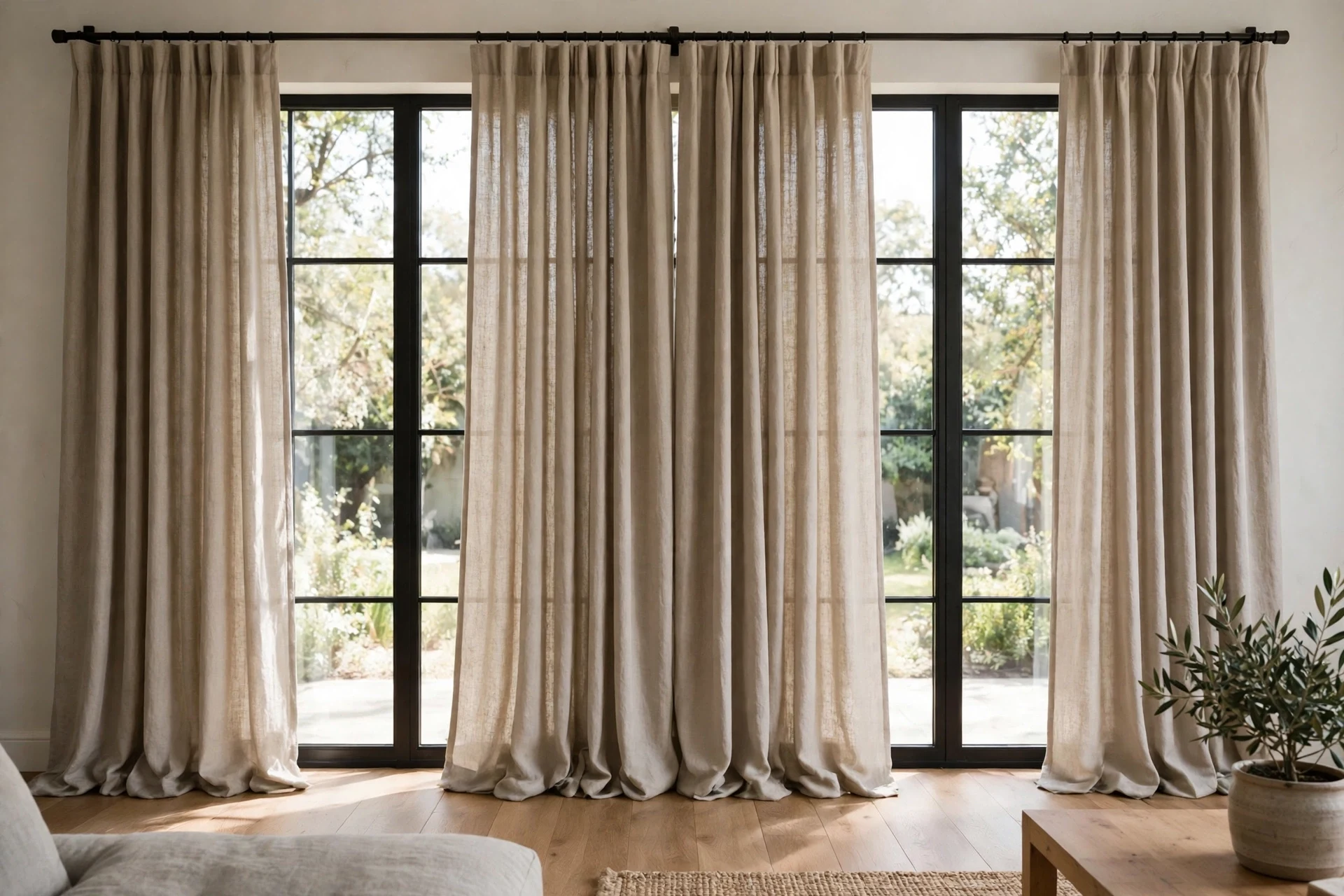
How Many Curtain Panels Do I Need
Panel count is one formula: rod width times fullness, divided by the finished width of one panel, rounded up. This guide gives the formula, the tables, and three worked examples.
The number of curtain panels you need is the rod width times the fullness ratio, divided by the finished width of one panel, rounded up. That is the whole calculation, and every table and example in this guide is that formula with different numbers in it. A standard window usually needs two panels, a wide window usually needs four, and a sliding door usually needs four to six, but the formula is what settles your window, because your rod width and your panel width are the numbers that decide it.
The panel-count formula in one line
Panels needed equals rod width times fullness, divided by finished panel width, rounded up. Written out: (rod width x fullness) / finished panel width, then round up to the next whole panel. The fullness ratio is the multiple of fabric you want on the rod: 1.5x for a tailored look, 2x for the standard look most rooms use, and 2x to 2.5x for a full look or for sheers. Pick the ratio before you count, because the ratio changes the answer more than anything else in the formula.

Each part of the formula has a rule of its own. The rod width is measured from bracket to bracket, end to end, leaving decorative finials out, because the finials hold no fabric. If no rod is fitted yet, the rod width is the window or door width plus the extension on each side, which for a standard window is usually 8 to 12 inches a side, and for a sliding door is 12 to 15 inches a side for the stack space. For the measuring steps themselves, see How to Measure for Curtains.
The finished panel width is the width the panel actually covers on the rod once its heading is made, not the headline width on the listing. A panel listed at 54 inches wide often finishes at 48 to 50 inches, because the heading takes about 4 to 6 inches. Use the finished width printed on the listing, and if the listing gives only one width without saying which it is, treat it as the pre-heading width and check before you buy.
Rounding up is not optional. A result of 2.4 panels means 3 panels, not 2, because 2 panels leave the curtains short and the gap shows in the middle when they are closed. It is always better to have slightly too much fabric than not enough, and the extra fabric gathers into the folds rather than hanging loose. Round up first, then deal with the odd-panel question in its own section below.
The ratio also follows the job, as numbers only: blackout or room-darkening curtains need only 1.5 to 2x, while decorative-only panels can sit close to 1x only where the fabric is heavy and the panel never has to close. Most ready-made panels are 40 to 55 in wide, which frames the tables below: the 50- and 54-in finished widths they use sit inside that range.
How many panels for common rod widths at 1.5x fullness
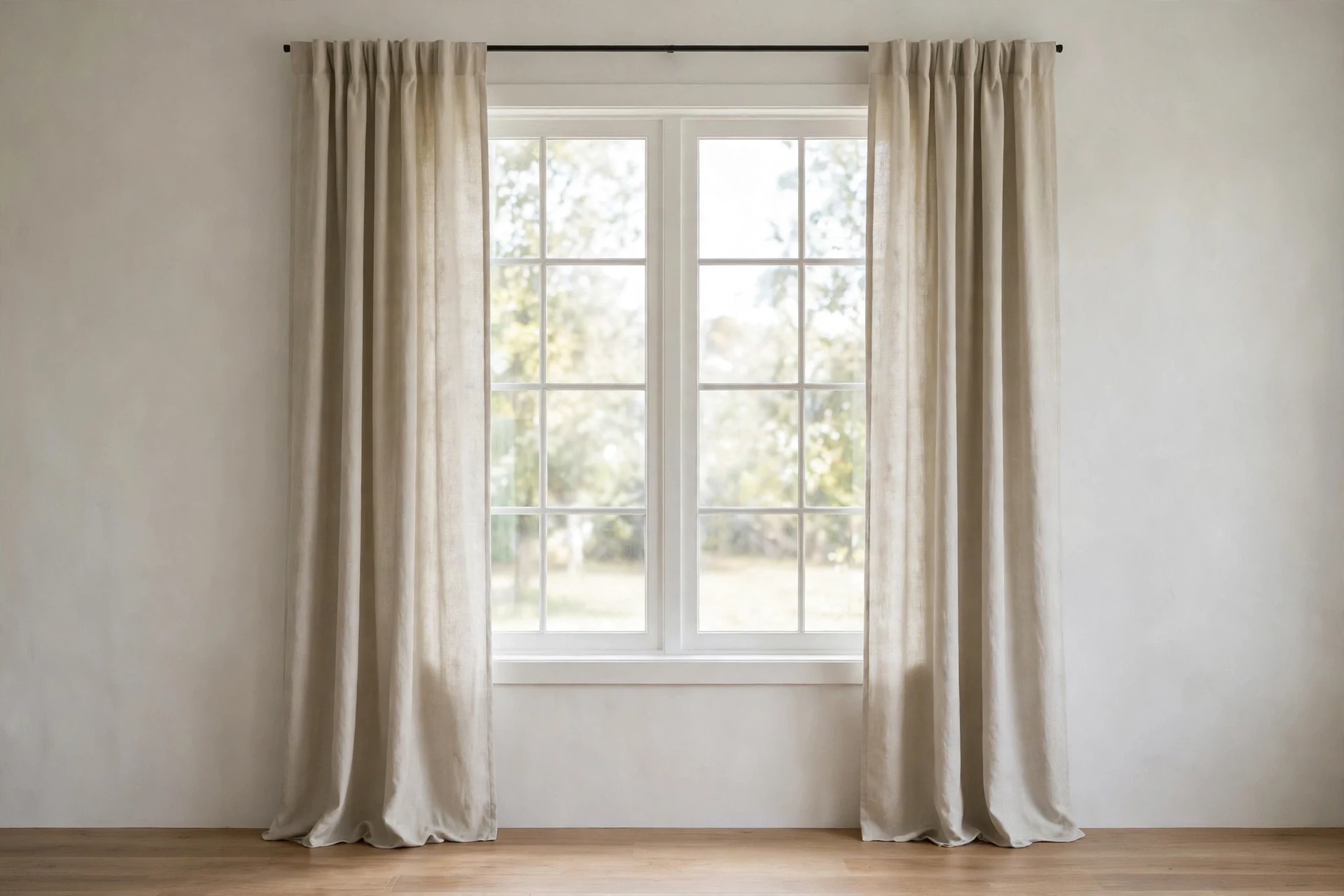
The table below gives the panel count for common rod widths at 1.5x fullness, the tailored ratio, for the two most common finished panel widths, 50 inches and 54 inches. Find your rod width in the left column, read across for your panel width, and buy that many panels. The fabric column shows the total fabric width the ratio calls for, so you can check the arithmetic yourself.
| Rod width | Fabric needed at 1.5x | Panels, 50 in finished | Panels, 54 in finished |
|---|---|---|---|
| 36 in | 54 in | 2 | 1 |
| 48 in | 72 in | 2 | 2 |
| 60 in | 90 in | 2 | 2 |
| 72 in | 108 in | 3 | 2 |
| 84 in | 126 in | 3 | 3 |
| 96 in | 144 in | 3 | 3 |
| 120 in | 180 in | 4 | 4 |
Read the table with two cautions. First, the 36-inch rod at 1.5x with 54-inch panels gives 1 panel, which is the arithmetic answer but a poor look on most windows: a single panel hangs on one side and leaves the window unbalanced, so buy 2 and use the extra as fullness unless the window is very narrow or the panel is purely decorative. Second, the table counts panels, not pairs: if panels are sold only in pairs, round the count up to the next even number, which is covered in its own section below.
How many panels for common rod widths at 2x fullness
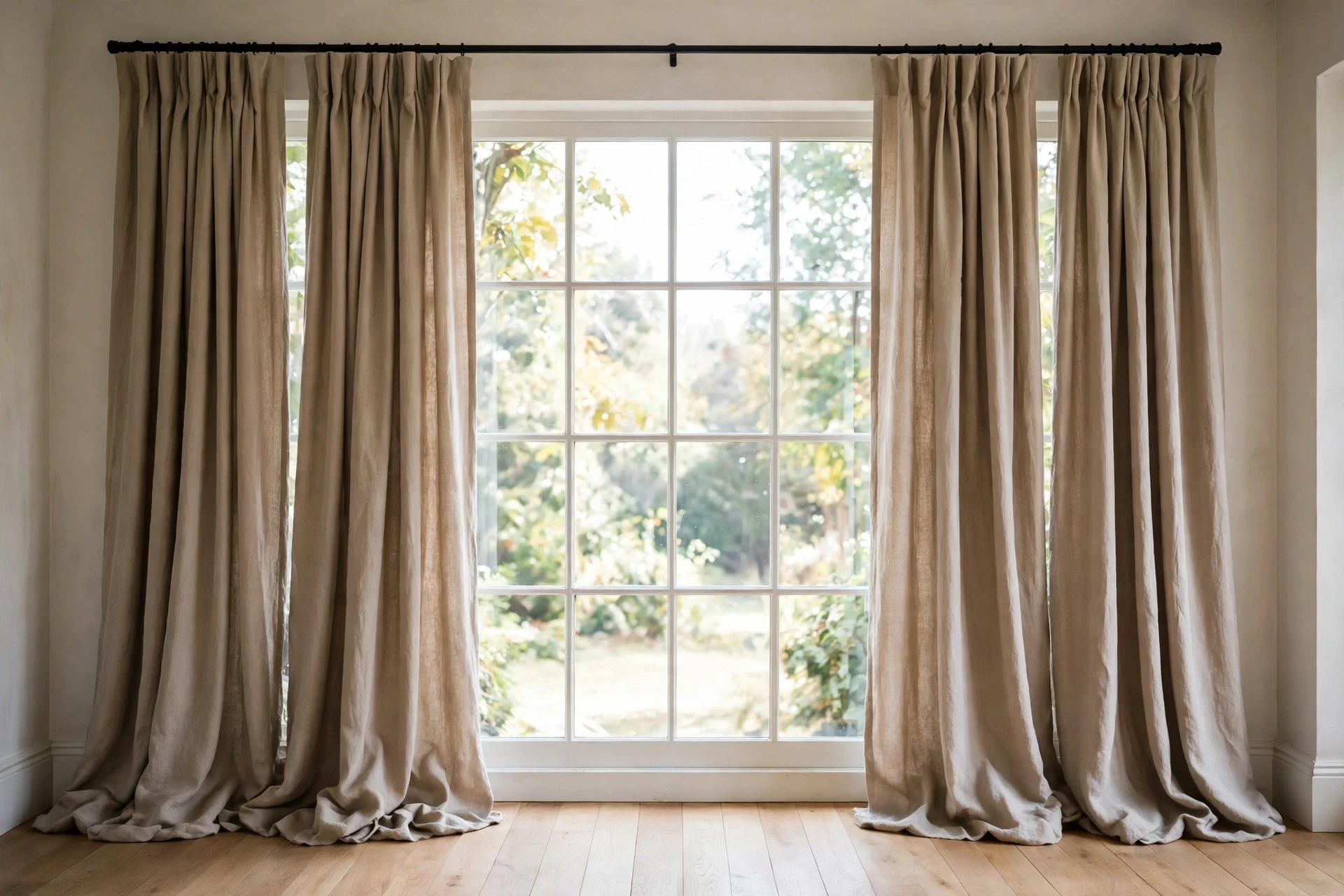
The table below gives the panel count for common rod widths at 2x fullness, the standard ratio most rooms use, for finished panel widths of 50 inches and 54 inches. Use it the same way: find your rod width, read across for your panel width, and buy that many panels. The fabric column shows the total fabric width at 2x, so the arithmetic stays visible.
| Rod width | Fabric needed at 2x | Panels, 50 in finished | Panels, 54 in finished |
|---|---|---|---|
| 36 in | 72 in | 2 | 2 |
| 48 in | 96 in | 2 | 2 |
| 60 in | 120 in | 3 | 3 |
| 72 in | 144 in | 3 | 3 |
| 84 in | 168 in | 4 | 4 |
| 96 in | 192 in | 4 | 4 |
| 120 in | 240 in | 5 | 5 |
Compare the two tables and the pattern is plain: at 2x the counts run one panel higher than at 1.5x on most rod widths, and that extra panel is what makes the closed look fuller. A 60-inch rod needs 2 panels at 1.5x and 3 at 2x. A 96-inch rod needs 3 at 1.5x and 4 at 2x. A 120-inch rod needs 4 at 1.5x and 5 at 2x. The jump from 4 to 5 on the widest rod is the odd-panel case, and the section below explains what to do with it.
If your rod width falls between two rows, use the next row up: a 66-inch rod is read as a 72-inch rod, because rounding down leaves the curtains short. If your finished panel width is neither 50 nor 54 inches, run the formula with your own number. For the standard lengths that go with these widths, see Curtain Sizes.
A standard window, worked through
Take a standard bedroom window 36 inches wide. The rod runs 6 inches past the frame on each side, so the rod width is 36 plus 12, which is 48 inches from bracket to bracket. The panels are a mid-weight fabric at 2x fullness, the standard ratio, and each panel finishes at 50 inches wide. Run the formula: 48 times 2 is 96 inches of fabric needed. Divide 96 by 50, which is 1.92, and round up to 2 panels.
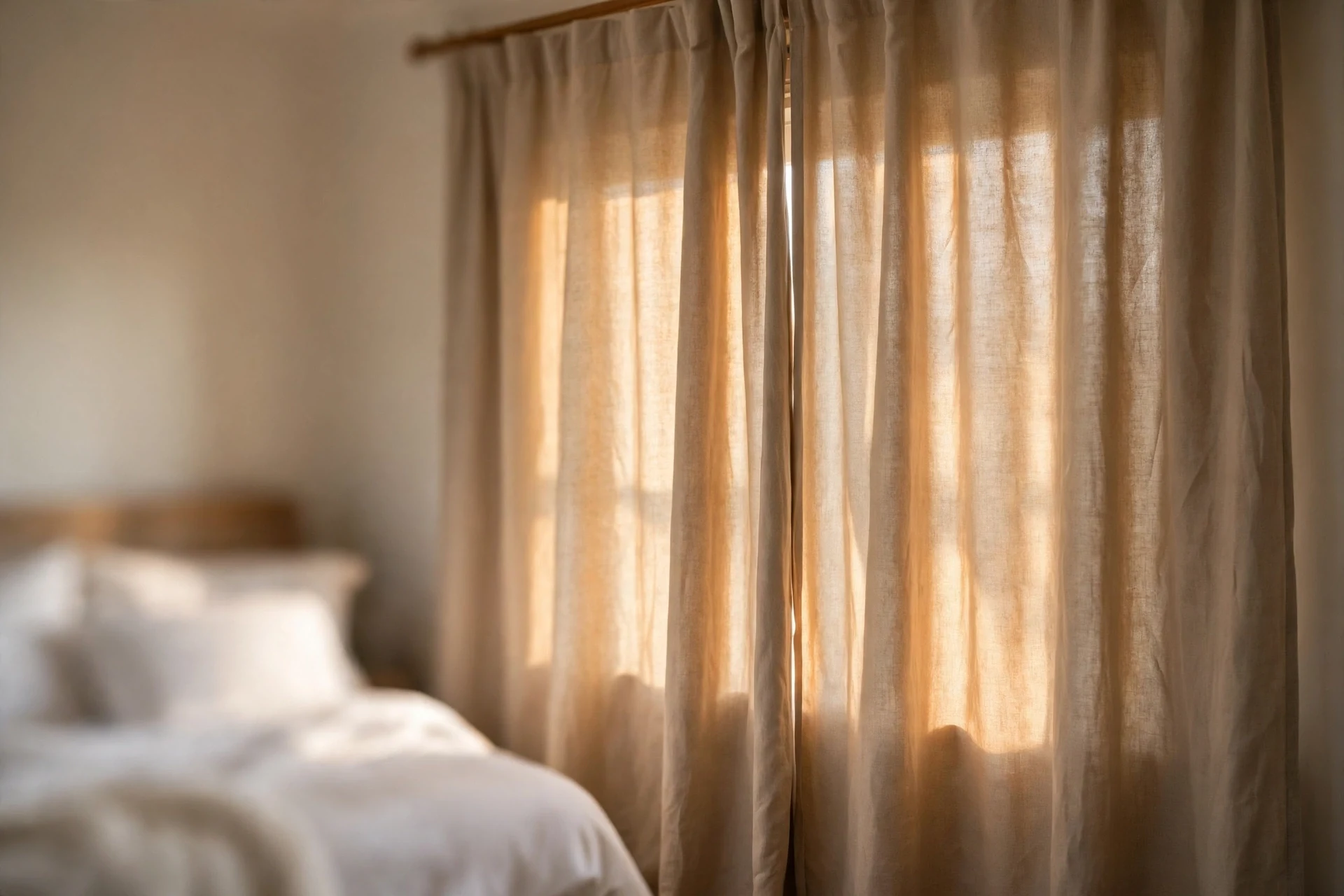
Two panels is the clean answer, and it is also the balanced one: one panel hangs on each side, they meet in the middle when closed, and they stack evenly when open. Check the closed look: 2 panels at 50 inches finished give 100 inches of fabric across a 48-inch rod, which is just over 2x, so the folds will be full without being bulky.
Now change one number and watch the answer move. If the same window used 54-inch finished panels instead, the count is 96 divided by 54, which is 1.78, rounded up to 2 panels again, so the panel count does not change but the fabric total rises to 108 inches. If the same window used 1.5x fullness instead, the fabric needed is 48 times 1.5, which is 72 inches, and 72 divided by 50 is 1.44, rounded up to 2 panels again.
A wide window, worked through
Take a wide living room window 72 inches wide, with the rod running 12 inches past the frame on each side, so the rod width is 72 plus 24, which is 96 inches. The panels are at 2x fullness, and each panel finishes at 50 inches wide. Run the formula: 96 times 2 is 192 inches of fabric needed. Divide 192 by 50, which is 3.84, and round up to 4 panels.
Four panels is the balanced answer for a wide window: two panels hang on each side, they meet in the middle when closed, and each side stacks evenly when open. Check the closed look: 4 panels at 50 inches finished give 200 inches of fabric across a 96-inch rod, which is just over 2x, so the folds will be full. Check the open look: each side gathers two panels into a stack of about 12 inches, so the wall on each side of the window needs about 12 inches of clear space, and if the wall is shorter the stack will cover some of the glass.
Now change the ratio and watch the answer move. At 1.5x fullness the same rod needs 96 times 1.5, which is 144 inches of fabric, and 144 divided by 50 is 2.88, rounded up to 3 panels. Three panels is the odd-panel case: two on one side and one on the other, which looks unbalanced unless the window itself is off-center. That is the moment to step up to 4 panels, either by buying a second pair or by choosing 2x fullness, which gives 4 panels naturally.
A sliding door, worked through
Take a sliding door 96 inches wide and 80 inches tall, used every day, with clear wall on both sides. The rod runs 15 inches past the frame on each side for the stack space, so the rod width is 96 plus 30, which is 126 inches. At 2x fullness, each panel finishes 50 inches wide. Run the formula: 126 times 2 is 252 inches of fabric needed. Divide 252 by 50, which is 5.04, and round up to 6 panels.
Six panels is the arithmetic answer and a good buying answer, because six panels split evenly across a center-open pair, three on each side.
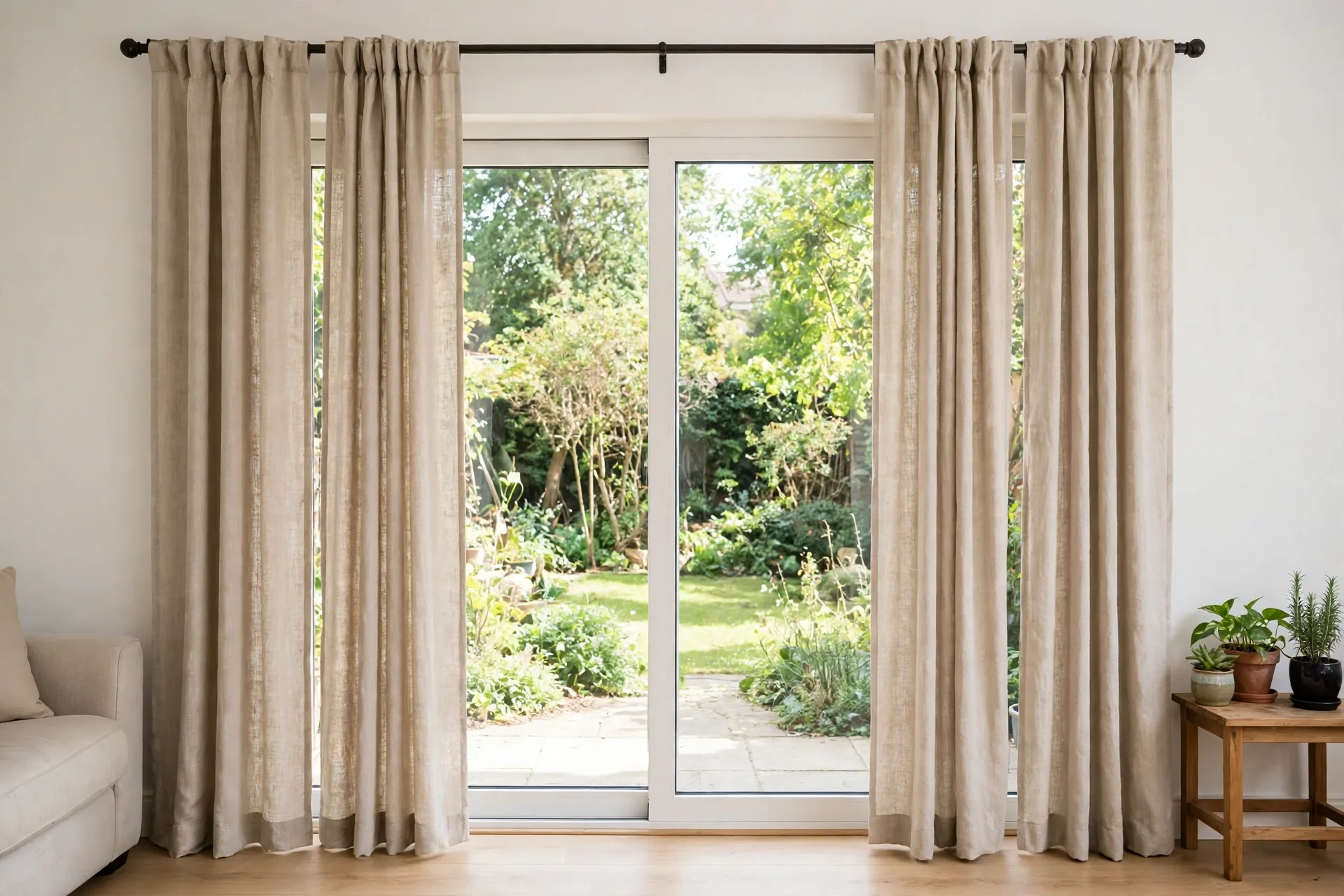
Six panels of 50 inches give 300 inches of fabric across a 126-inch rod, about 2.4x fullness, a fuller look than planned. Wider panels do not change the count here: with 54-inch finished panels the count is 252 divided by 54, which is 4.67, rounded up to 5 panels, and five cannot split evenly, so step up to 6 panels of 54 inches, three on each side, which gives 324 inches of fabric, about 2.6x fullness.
Check the stack, because a sliding door is where the stack decides whether the door works. Six 50-inch panels gather into about 36 inches of stack across both sides, or 18 inches a side, which is more than the 15 inches of stack space the rod provides, so the open panels would cover a little of the glass. The fix is to give the rod more room: run it 18 inches past the frame on each side instead of 15, which makes the rod 132 inches, needs 264 inches of fabric at 2x, and still takes 6 panels of 50 inches, which give 300 inches across a 132-inch rod, about 2.3x, with 18 inches of stack space a side that the open panels fit inside. Always check the stack on a sliding door after the count, because the count alone does not say whether the door stays clear.
Other window shapes count differently. A bay window takes one panel per section of the bay, or a flexible bay rod with 4 or more panels. A corner window takes 2 to 4 panels with separate or custom corner rods. An arched window is measured by mounting the rod above the arch and counting by the width beneath the arch.
The room changes the count too. A bedroom takes double panels for privacy and light control, with blackout or thermal lining and extra fullness. A living room layers sheers with heavier drapes, and decorative panels suit it even where the windows are rarely covered. A kitchen often takes a single panel or a cafe curtain, because natural light and easy cleaning come first. A patio or sliding door takes 4 or more panels, with stack-back space and easy access to the door. Double-width patio panels, about 100 in per panel, suit a sliding door well: two of these often give a cleaner line than four standard panels.
Odd panels: when the count comes out uneven
The formula often returns an odd number, 3 or 5, and an odd number needs a decision, because curtains hang in pairs. A center-open pair splits the fabric evenly across the middle, so it needs an even count: 2, 4, or 6 panels. An odd count puts more fabric on one side than the other, and the window looks lopsided when the curtains are open, with one stack visibly wider than the other. It also closes unevenly, because the fuller side meets the middle with more fabric than the thinner side.
There are three good answers to an odd count. First, round up to the next even number: 3 becomes 4, and 5 becomes 6. This is the simplest answer and the one this guide recommends where the wall space allows it, because the extra panel adds fullness and the symmetry is worth the cost of one more panel. Second, change the finished panel width: a wider finished panel can drop the count by one — in the sliding-door example, 54-inch panels gave 4.67, rounded up to 5, against 6 for 50-inch panels — so step up to 6 for an even split. Third, change the ratio by a notch: stepping from 2x to 1.5x can drop the count by one on some rod widths, though it also flattens the closed look.
An odd count is fine where the window itself is off-center or the draw is one-way. A single panel on a narrow window is an odd count of 1, and it looks right because the window is narrow and the panel dresses one side. A one-way draw on a sliding door gathers all the fabric on one side by design, so an odd total can still look intentional there. The rule is not that odd counts are wrong, but that an odd count on a centered window with a center-open pair looks like a mistake, and the fix is one of the three answers above.
Space the panels evenly once the count is set: divide the rod space by the number of panels, with even stack-back on both sides for symmetry, so no side carries more fabric than the other.
When panels are sold only in pairs
Many panels are sold as a pair, two panels in one pack, and some are sold as a single panel, one panel in one pack, and the listing does not always make the difference obvious. Product photos often show two panels covering a window while the description says one panel, so check the quantity before you buy: look for the words pair, set of 2, or 2 panels, and if the listing says none of those, assume it is a single panel. This check matters more than any other in the panel count, because buying one pack when you need two panels is the most common ordering error in curtains.

If panels are sold only in pairs, round your count up to the next even number. A count of 3 becomes 2 pairs, which is 4 panels. A count of 5 becomes 3 pairs, which is 6 panels. A count of 2 stays 1 pair, and a count of 4 stays 2 pairs. The extra panel from rounding up is not wasted: it adds fullness, and a slightly fuller curtain looks better than a slightly thin one. Buy the pairs first and check the finished width of the pair on the listing, because a pair listing sometimes gives the width of one panel and sometimes the width of both together, and mixing those up doubles or halves your count. If panels are sold singly, buy the exact count in one order from the same listing, because panels from different dye lots can differ slightly in color.
Panel-count mistakes that leave a gap in the middle
The most common panel-count mistake is counting by the window width instead of the rod width. The rod runs wider than the window by the extension on each side, and a count based on the window alone leaves the curtains short by that extension on both sides. The closed panels then cannot meet in the middle, and a gap of bare rod shows at the center. Always measure the rod, bracket to bracket, and run the formula on that number.
The second mistake is counting by the headline panel width instead of the finished width. A 54-inch headline panel that finishes at 48 inches gives 6 inches less coverage per panel than the count assumed, and across 4 panels that is 24 inches of missing fabric, which is half a panel. Use the finished width, and if the listing does not give it, measure a panel you already own or ask before you buy.
The third mistake is rounding down instead of up. A result of 2.4 panels is 3 panels, not 2, and a result of 3.8 is 4, not 3. Rounding down saves the cost of one panel and costs the whole look, because the curtains cannot close. Other mistakes follow the same pattern: forgetting the stack space on a sliding door, which leaves the count right and the door blocked, and ordering one pack when the listing sells singles, which halves the count.
Natural fabrics may shrink, so order slightly longer panels if shrinkage is a concern. Mixing panel types is a sound way to layer: a sheer under a blackout panel, or a decorative panel over a functional one, each doing its own job. Four more mistakes are worth naming: overcrowding a narrow window, because too many panels make the window look smaller; choosing the style before measuring, so the count is fitted to a look instead of the rod; mixing incompatible fabrics or patterns without intention; and misjudging the panel length, by counting before measuring from rod to floor or sill.
Frequently asked questions about curtain panel counts
Most panel-count questions come down to the formula, the finished width, and what to do with an odd number.
How many curtain panels do I need for a standard window?
Most standard windows need 2 panels, one for each side. Run the formula to confirm: a 48-inch rod at 2x fullness needs 96 inches of fabric, and with 50-inch finished panels that is 96 divided by 50, which is 1.92, rounded up to 2 panels.
How many panels do I need for a 72-inch window?
A 72-inch window usually has a rod of about 84 to 96 inches, and at 2x fullness with 50-inch finished panels that needs 4 panels. A 96-inch rod needs 192 inches of fabric, and 192 divided by 50 is 3.84, rounded up to 4.
Can I use just one curtain panel?
One panel works for a very narrow window, a small window, or a decorative panel that never closes. On a standard window one panel looks unbalanced, hangs on one side, and cannot cover the rod when closed. Use two or more panels for any window you need to cover.
What if my curtains do not fully close?
The count is short, so you probably need more panels or wider ones. Recalculate with the formula rather than stretching the panels, because stretched fabric leaves gaps at the edges and the middle. Re-run it with your rod width, your fullness ratio, and the finished width of your panels, and check that you used the finished width rather than the headline width, and that the ratio used was the one the room actually needs. A gap in the middle usually means the count was rounded down or the headline width was used.
What is the finished width of a curtain panel?
The finished width is the width the panel covers on the rod once its heading is made. It is usually 4 to 6 inches less than the headline width, because the heading takes that much fabric. A panel listed at 54 inches often finishes at 48 inches, so always use the finished width in the formula.
Do I count panels or pairs?
Count panels first, then convert to packs. If panels are sold singly, buy the panel count. If they are sold in pairs, round the panel count up to the next even number and buy that many panels as pairs. Check the listing for the words pair or set of 2 before you order.
How many panels do I need for a sliding door?
A sliding door usually needs 4 to 6 panels, depending on the rod width and the finished panel width. A 126-inch rod at 2x fullness needs 252 inches of fabric, which is 6 panels at 50 inches finished, three on each side. Check the stack as well as the count, because the open panels must clear the doorway.
Does the fullness ratio change the panel count?
Yes, more than anything else in the formula. At 1.5x a 72-inch rod needs 3 panels of 50 inches finished, and at 2x the same rod needs 3 panels too, but at 2x a 96-inch rod needs 4 where 1.5x needs 3. Run the formula at the ratio you actually want, not at a ratio chosen after the count.
For the measuring steps behind the rod width, see How to Measure for Curtains, and for the standard lengths that go with these widths, see Curtain Sizes.
This guide is research-based curation: we compared maker specifications, published reviews, and current prices. Read how we choose.