 Best
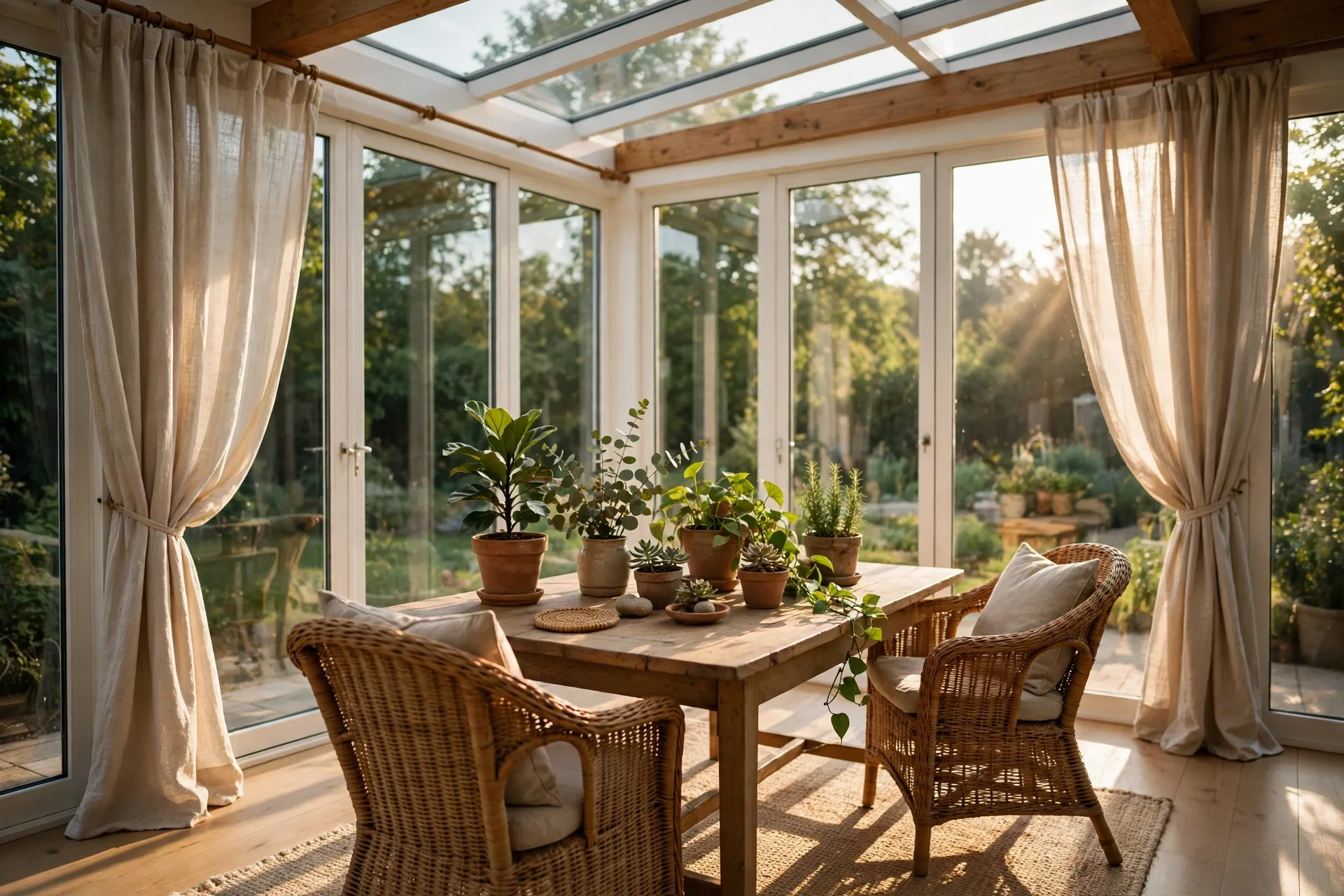
Best Curtains for Sunroom
A sunroom asks three different jobs of one curtain: cool the heat, tame the glare, and keep privacy. This guide sorts each job by how the room is used, and covers conservatory glass too.
The best curtains for a sunroom are the ones that treat heat, glare, and privacy as three separate jobs, because a curtain that blocks heat may also block the view, and a curtain that gives privacy at night may make the room dark by day. Decide which job matters most for how the room is used, then choose the layer that does that job, and the sunroom stays usable from morning coffee to evening television.
This guide sorts the heat, the glare, and the privacy, layer by layer, including no-drill options for frames.
Sunroom curtain picks by use
The picks below are sorted by the sunroom job each one does, from softening bright glass to darkening the room for television, so start with the job your sunroom needs most. Sizes below are the listing sizes at the time of checking; confirm the size on the listing before you order. Check the light level, the lining, the finished length, and the care label on the listing for the panel you choose.
As an Amazon Associate, we earn from qualifying purchases.
| Pick | Type | Light job | Best for |
|---|---|---|---|
| 1 | Sheer linen sunroom panels | Sheer | A bright sunroom that needs soft light and a view |
| 2 | Light-filtering part-lined sunroom panels | Light filtering | A sunroom desk that needs glare control without darkness |
| 3 | Thermal sunroom panels | Room darkening, thermal triple weave | A sunroom that overheats in summer and chills in winter |
| 4 | Blackout sunroom panels | Blackout | A sunroom used for television or guest sleep |
| 5 | Sheer plus lined layered sunroom panels | Sheer plus lined | A sunroom dining area used day and evening |
| 6 | Fade-resistant outdoor-look sunroom panels | Light filtering | A south-facing sunroom with strong all-day sun |
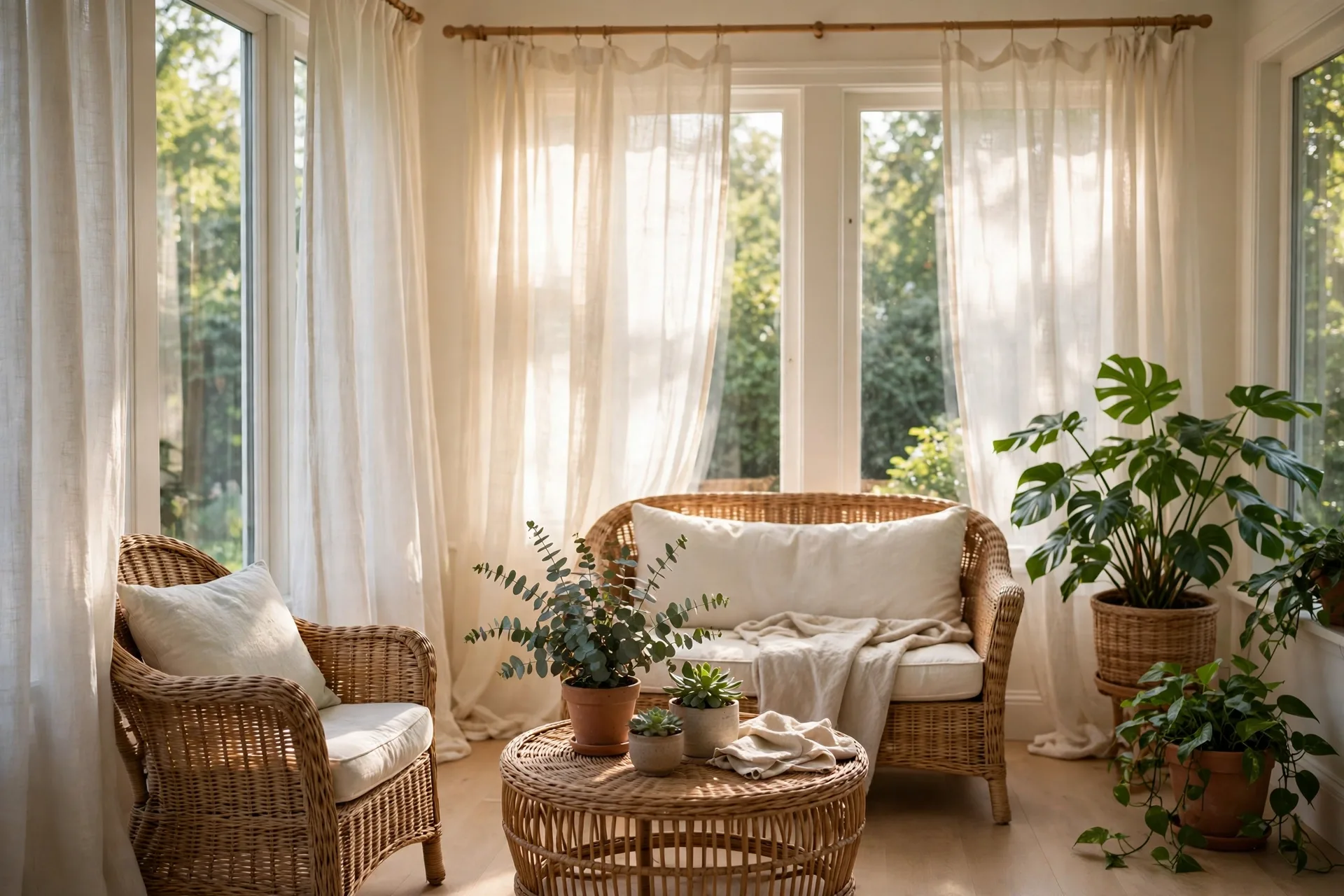
1. Sheer linen sunroom panels: best for a bright sunroom that needs soft light and a view
Best for: A bright sunroom where the job is softening harsh sunlight without losing the view or the airy feeling, and the room is used mostly by day.
Key features: Linen-blend semi-sheer panels, 20% linen and 80% polyester, in Pure White, rod pocket heading, 52 by 90 inches, 2 panels, machine washable.
Pros: Keeps the room bright while taming glare, linen texture suits a garden-facing room, light fabric draws easily.
Cons: Little privacy at night once indoor lights are on, no real darkness or heat blocking alone, a linen blend, not pure linen, so the texture is softer than a true linen weave, pale white shows marks sooner than a deeper shade.
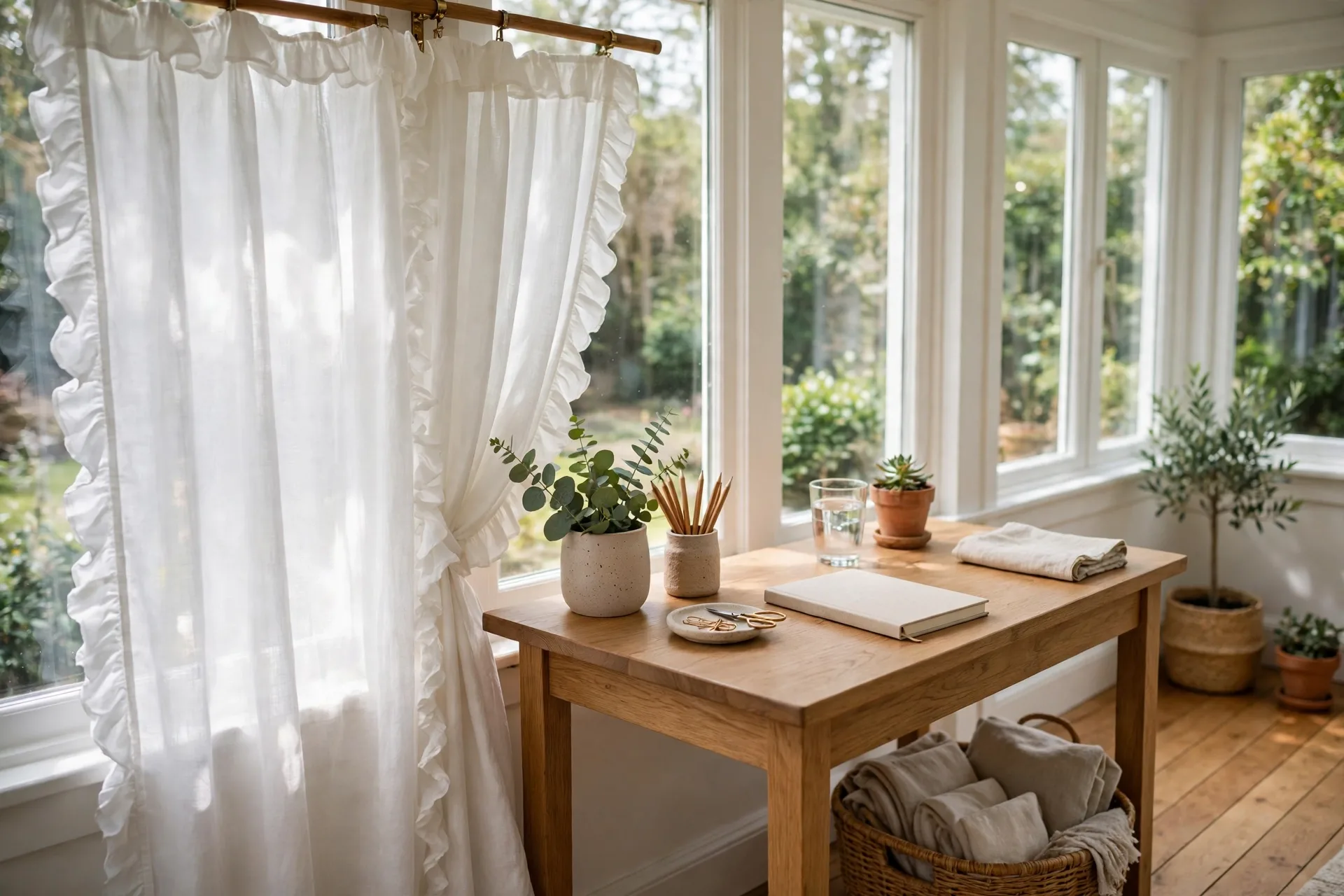
2. Light-filtering part-lined sunroom panels: best for a sunroom desk that needs glare control without darkness
Best for: A sunroom desk or reading chair where screen glare and harsh sun make work hard, but the room must stay bright enough to work in.
Key features: White light-filtering semi-sheer panels with ruffle edges, partially lined, rod pocket heading, 52 by 84 inches, 2 panels.
Pros: Cuts glare on a screen without darkening the room, the partial lining slows fading, good daytime privacy for a lined panel.
Cons: Limited night privacy alone, the ruffle edges suit a softer room, not a plain desk wall, only partially lined, so the lining does not cover the full panel, no strong heat blocking on its own.
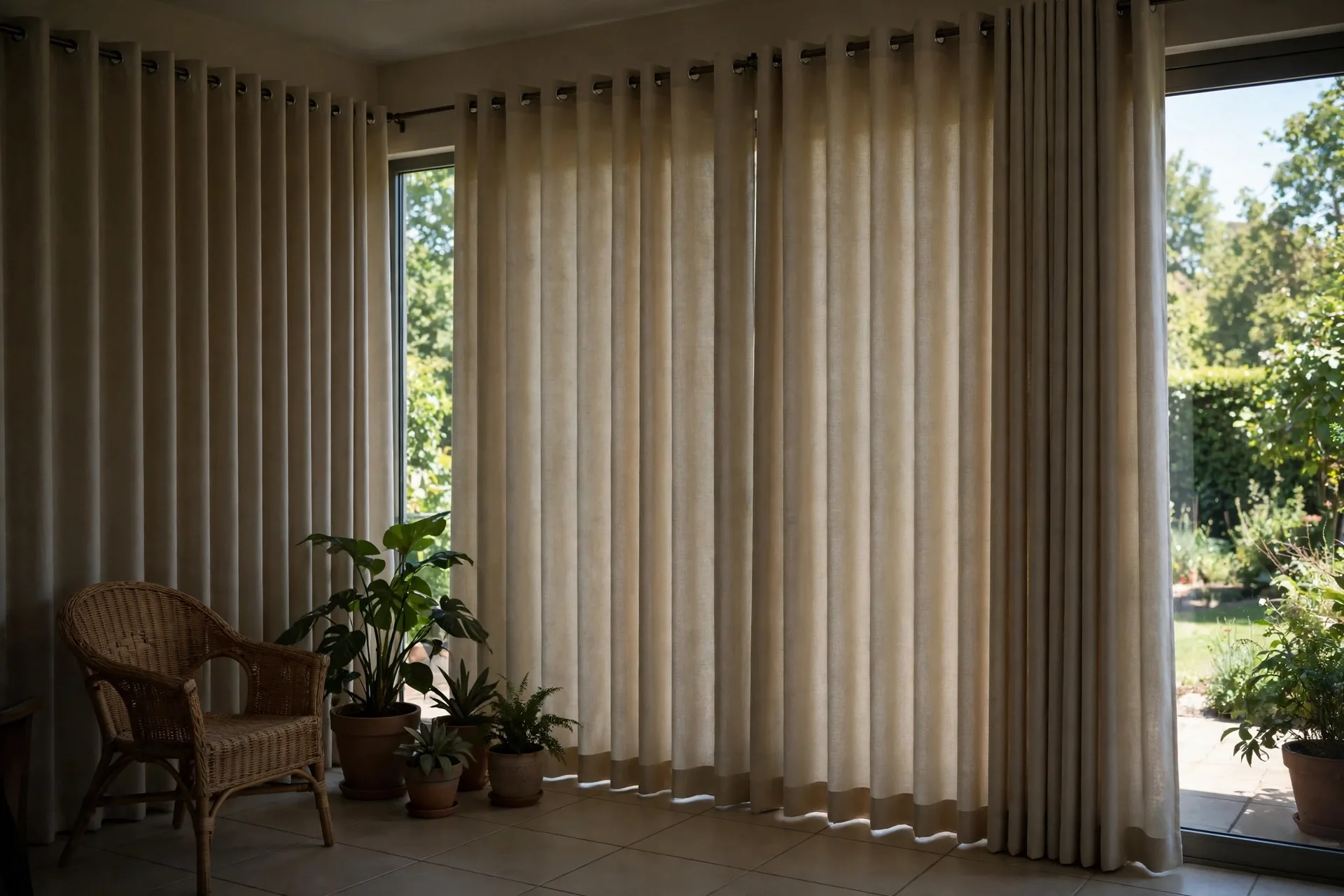
3. Thermal sunroom panels: best for a sunroom that overheats in summer and chills in winter
Best for: A sunroom that is too hot in summer and too cold in winter, where the curtain must help with temperature as well as light.
Key features: Natural-color thermal-insulated panels, 52 by 84 inches, 2 panels, triple-weave fabric the seller states blocks 85 to 99% of light, grommet heading with 1.6-inch silver grommets, machine washable.
Pros: Softens heat gain in summer and cold air in winter alongside its light job, fuller drape, light face keeps a thermal panel from looking heavy.
Cons: No separate lining, the thermal work comes from the triple weave, so do not expect a lined panel, 85 to 99% blocking is strong dimming, not guaranteed full blackout, heavier than unlined panels, so check the rod and track rating.
4. Blackout sunroom panels: best for a sunroom used for television or guest sleep
Best for: A sunroom used for television in the afternoon or for a guest sleeping over, where the room must go dark on demand.
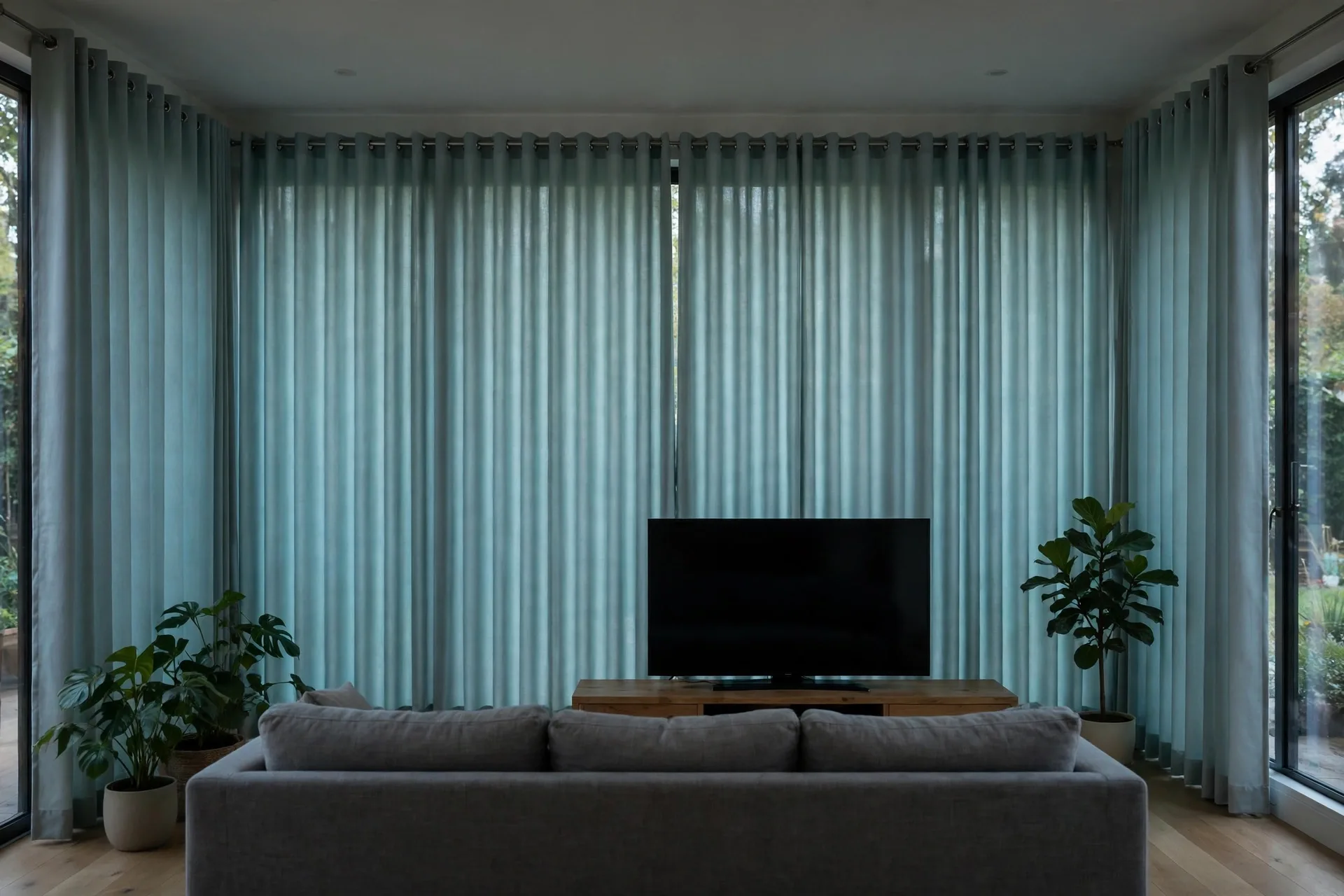
Key features: Black back behind a plain face, 52 by 84 inches, 2 panels, grommet heading, 100% polyester, Aqua color, full closed coverage, heavier fall.
Pros: Full darkness for a screen or for sleep, good night privacy, blocks the strongest glare completely.
Cons: Makes the room dark by day when closed, so pair it with a sheer day layer where the room is also used in daylight, heavier than unlined panels.
5. Sheer plus lined layered sunroom panels: best for a sunroom dining area used day and evening
Best for: A sunroom dining area where meals need soft daylight by day and privacy with warm light in the evening, without two separate windows.
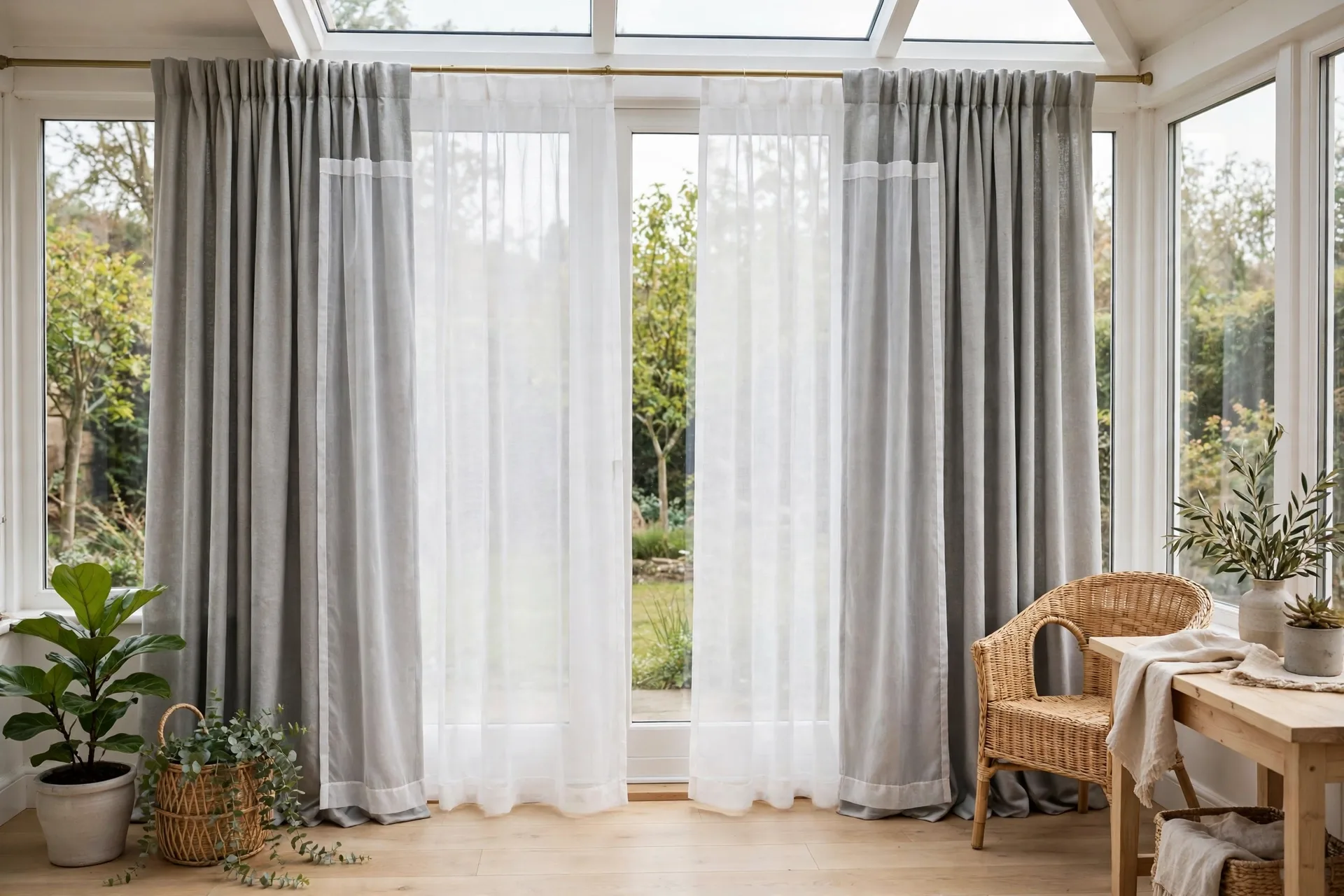
Key features: Blackout panels with a sheer overlay sewn onto the same panel, so the two layers hang together on a single rod, Grayish White, thermal-insulated, grommet heading, 52 by 84 inches, 2 panels, tiebacks included.
Pros: Soft light by day and privacy by evening, the sheer keeps the room airy while the blackout layer does the evening work, suits a room used all day.
Cons: The layers are sewn together and cannot be drawn separately, so the sheer cannot stay closed while the blackout opens, two layers on one panel are heavier than a single layer, so check the rod rating, keep the fullness light so the folds do not crowd the glass.
6. Fade-resistant outdoor-look sunroom panels: best for a south-facing sunroom with strong all-day sun
Best for: A south-facing sunroom where the sun hits the glass all day and ordinary fabric fades within a season.
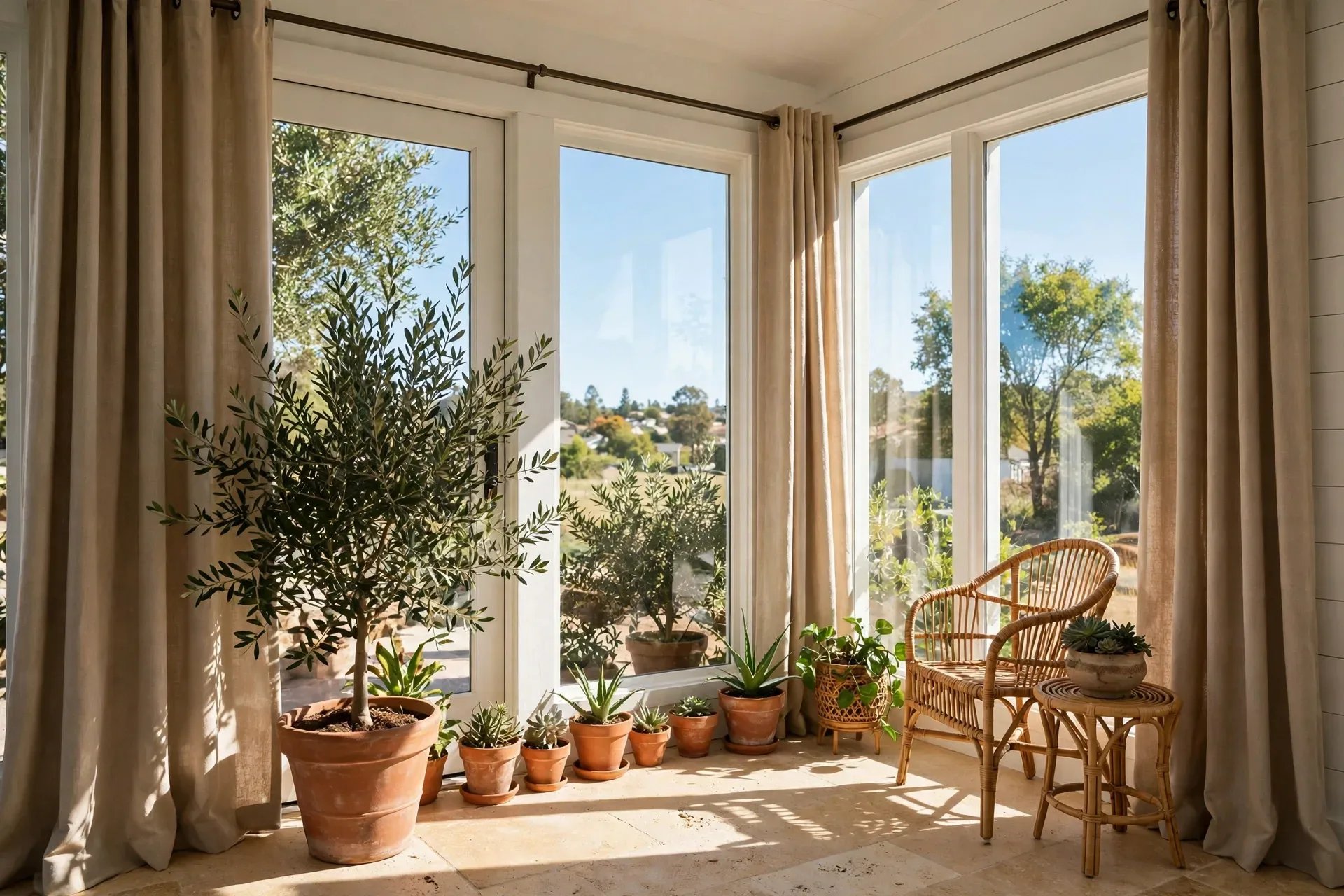
Key features: Beige outdoor-look panels in breathable 100% polyester, UV and fade resistant as the seller states, waterproof, rust-proof silver grommets, single panel, 52 by 84 inches.
Pros: Holds color far longer in strong sun than ordinary fabric, resists moisture and mildew in a humid sunroom, breathable weave lets air through.
Cons: Sold as a single panel, so order two for a pair, a stiffer hand than linen or cotton, so check the drape before ordering, light colors still need a lining behind them where privacy matters at night.
Heat, glare, and privacy: three separate jobs
Heat, glare, and privacy are three separate jobs, and a sunroom curtain that does one well may do another badly, so the first step is to name which job bothers you most. Heat is the temperature job: the sun warms the glass, the glass warms the room, and the room becomes unusable on a hot afternoon. A thermal lining helps here, because it adds a barrier between the glass and the room, and a light-colored face helps too, because it reflects sunlight rather than absorbing it. But a thermal lining alone will not cool a sunroom the way shade outside the glass would, so treat it as help, not as air conditioning. For the heat job in full, see Best Thermal Insulated Curtains.
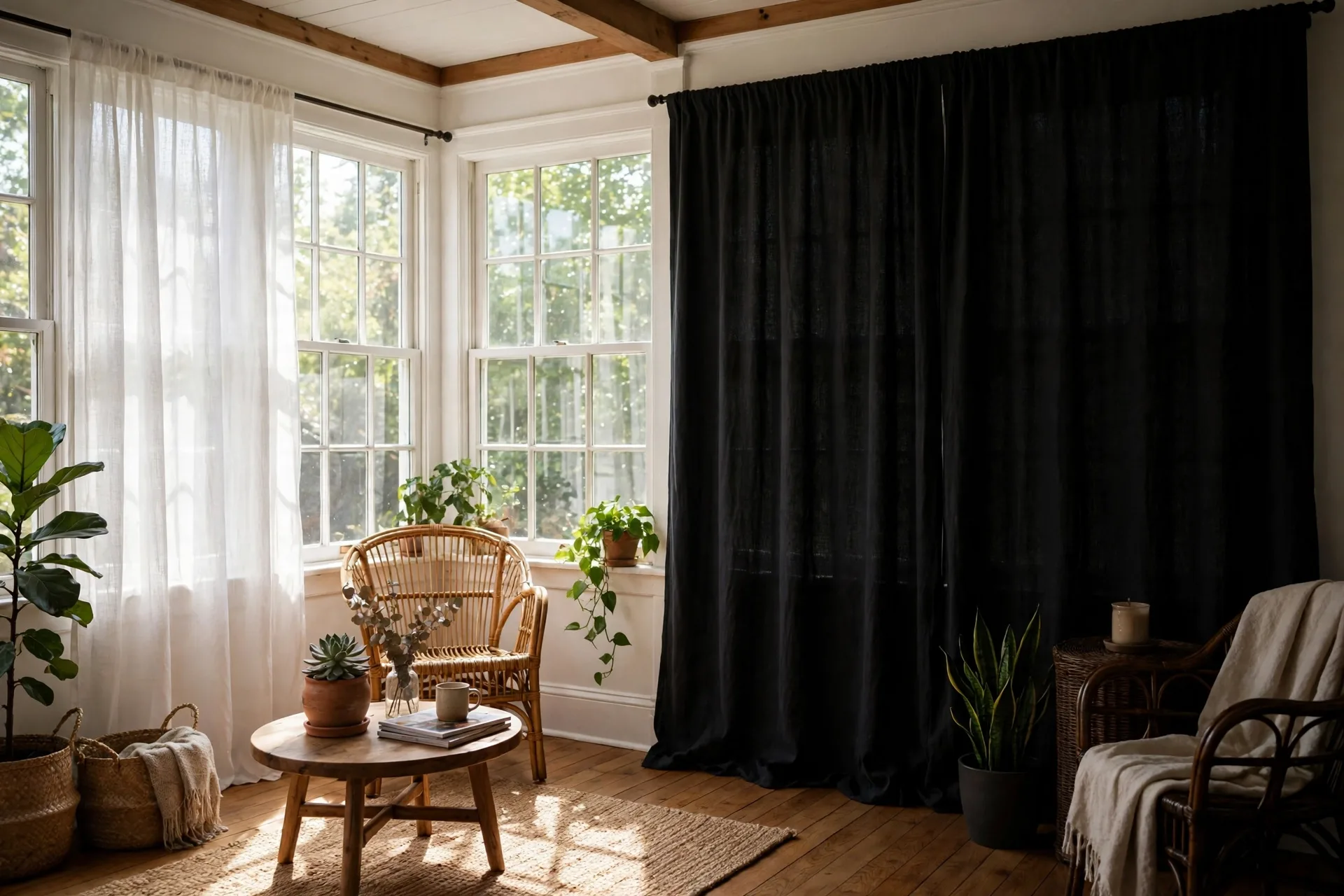
Glare is the light job: the sun hits a screen, a table, or a page, and the bright patch makes it hard to see. A sheer or light-filtering panel helps here, because it spreads the sunlight evenly instead of letting it fall in a hard patch, and it does so without darkening the room. Glare changes through the day as the sun moves, so a curtain that can be drawn halfway, or a sheer that stays closed while a lined panel opens, gives more control than a single panel that is either open or shut.
Privacy is the view job: the sunroom is mostly glass, so anyone outside can see in, and the room feels exposed even when it is empty. A sheer gives daytime privacy while keeping the view out, because it blurs the view in without blocking the view out, but it gives almost no privacy at night once indoor lights are on. A lined or blackout panel gives night privacy, but it blocks the view as well. The answer for a sunroom used day and evening is a layered pair, sheer by day and lined by night, so each job gets its own layer. Name the job that bothers you most, and choose the layer that does that job first.
Check which direction the room faces first, because orientation changes the job. A north-facing room needs warming colors and light, while a west-facing room takes the strongest afternoon sun and needs the strongest heat and glare control. A sunroom is also a multi-use room, and each use changes the layer: reading nooks need glare control, dining areas need washable options, and work stations, board games, homework, and laptop work each change the layer choice. A blackout layer protects furniture and face fabric from sun damage too, not just the room from light, so it saves the sofa and the curtains themselves from fading.
Sheer, lined, and thermal layers by sunroom use
A sunroom television needs darkness on demand, because afternoon sun washes out the screen. A blackout panel suits the television wall best, because it goes fully dark when closed and opens fully when the television is off, and a sheer day layer behind it keeps the room bright between viewings.
A sunroom dining area needs soft light by day and privacy in the evening, because meals feel better in even light than in harsh glare.
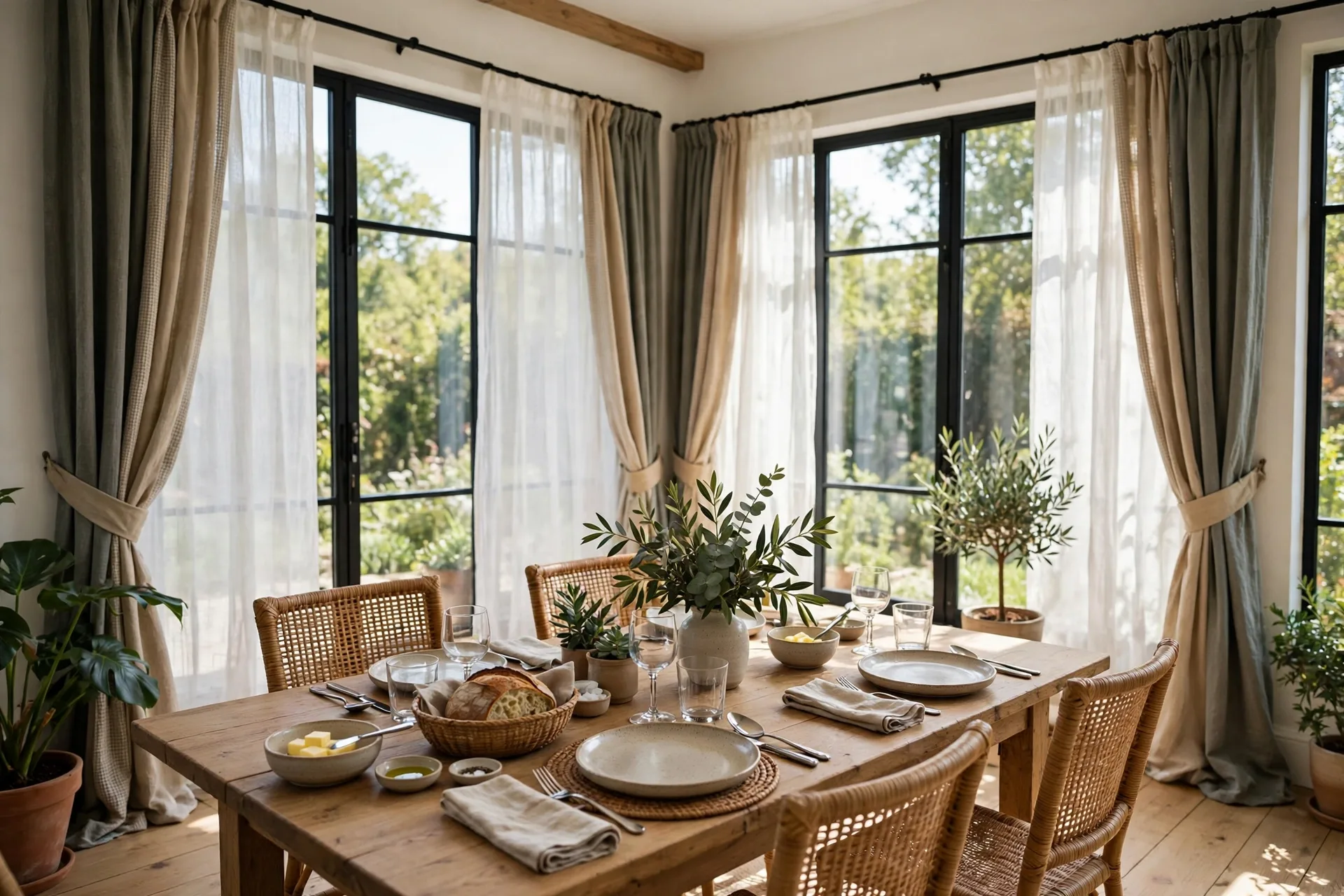
A layered pair suits the dining area best: sheer by day for soft light and daytime privacy, lined in the evening for privacy with warm light. A sunroom used for guest sleep needs full darkness from a blackout panel with a heading that closes without gaps at the top, hung wide so the panels meet without a center gap. For the sleep job in full, see Best Curtains for Bedroom.
A blackout layer also cuts noise, which matters for laptop work in a sunroom. Decorative-only panels, stationary panels, valances, and faux Roman blinds are style-only options: panels that need not cover the window at all. A white privacy lining softens glare and protects the face fabric without darkening the room, while a blackout lining in white, beige, or gray suits television and office use. Thermal lining works in lighter colors too: modern thermal linings block heat in light colors, not only dark ones. Fit thermal panels to make a barrier: extend them beyond the frame and down to the floor, layer a thermal outer with sheers underneath, and mount the rods close to the wall or ceiling to minimize air gaps. A chain weight along the sheer hem helps sheers hang straight and settle back into place after a breeze. Voile runs at 2x to 2.5x fullness, with patterned voile in tone-on-tone prints, delicate stripes, or soft geometrics, and voile works as a base layer under heavier curtains. Bamboo and woven wood blinds pair with curtains: bamboo blinds insulate a little, cool in heat and warm in cold, and pair well with sheers, with the rods mounted outside and above the frames so the shades operate freely.
Fade-resistant fabrics and light colors that hold up in sun
Fade resistance is the sunroom fabric decision, because a sunroom window gets more sun than any other window in the house, and ordinary fabric fades, yellows, and weakens within a season. Solution-dyed fabrics hold color longest, because the color runs through the fiber rather than sitting on its surface. Polyester holds color well in sun, resists wrinkles, and washes easily, which suits a sunroom where the curtains open and close daily. Outdoor-look fabrics, made to resist fading, moisture, and mildew, suit a sunroom too, because a sunroom's air is often humid and its sun is strong. For the sheer job in full, see Best Sheer Curtains, and for natural fabric behavior, see Best Linen Curtains.
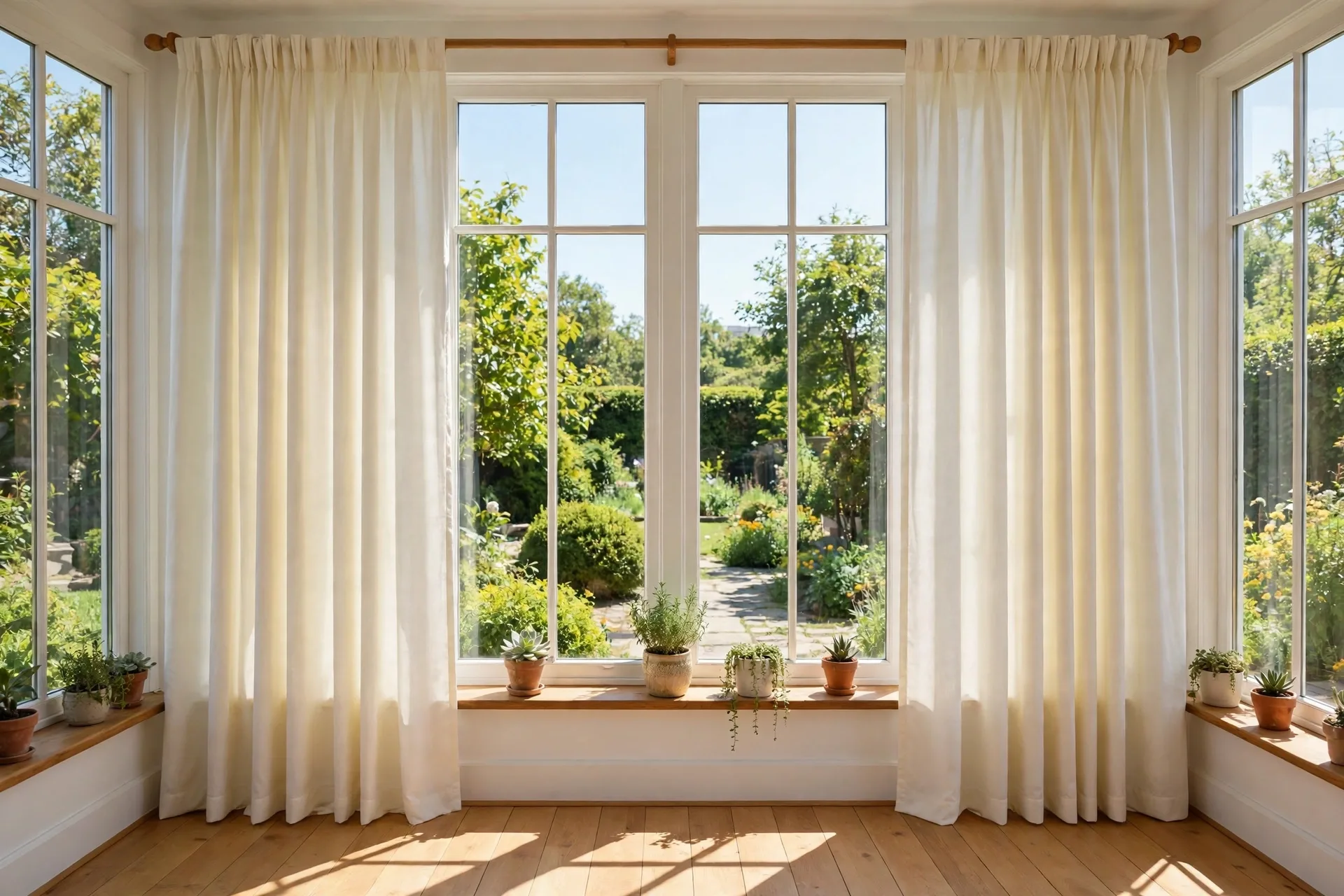
Linen and cotton feel best in a sunroom, because their natural texture suits a garden-facing room, but both fade faster than polyester in strong sun, and linen wrinkles while cotton shrinks if washed hot. If linen or cotton is the look you want, choose a lined panel, because the lining takes the sun instead of the face fabric. Velvet and silk are the fabrics to avoid in a sunroom, because velvet traps heat and dust while silk fades and weakens fast in direct sun.
Light colors suit a sunroom best, because they reflect sunlight and heat instead of absorbing it, and they keep the room feeling bright and airy. White, cream, pale gray, and soft pastels all suit a sunroom, and a light color on the face of a lined panel gives the room brightness while the lining does the light and heat work behind it. Dark colors absorb heat and fade fastest, so keep them out of a sunroom unless the room is a media corner that wants darkness, and even there choose a dark lining behind a light face rather than a dark face in full sun. Check the fabric's fade resistance on the listing before ordering, and ask for a swatch to leave in the sun for a week where the choice is between two fabrics.
Test before committing: start with one window as a test, test color swatches in the actual sunroom light through the day, and feel fabric samples before ordering. Cleaning and maintenance follow the weight: lightweight panels machine-wash on gentle, heavy panels often need professional cleaning, and removable panels make washing practical. Linen in a sunroom should be pre-washed to avoid shrinkage, and linen has weight, so the brackets must be sturdy, embrace the wrinkles, because pressed linen does not stay pressed in sun. Natural texture goes beyond linen and cotton: muslin is soft, breathable, and affordable, and layers for warmth, jute is rugged and durable in high traffic, and its natural tones hide wear, canvas is sturdy, sun-fade resistant, and easy to wash, and softer pre-washed, quilted fabric gives warmth for cooler climates and layers with lighter fabrics seasonally, macrame in a tighter weave gives more privacy. Botanical prints follow the room size: large prints suit spacious rooms, small prints suit cozy rooms, and use UV- and fade-resistant fabric for prints. Stripes change the room's shape: vertical stripes make a room feel taller, horizontal stripes make it feel wider, and diagonal stripes add drama, so balance striped curtains with solids elsewhere. Ombre and two-tone follow a simple rule: dark at the bottom feels grounding, dark at the top creates drama, a 70/30 split is more interesting than 50/50, and the ombre shades can be pulled into pillows, throws, or accessories for a cohesive design. Vintage lace panels suit a period sunroom: Nottingham lace for Victorian elegance, crochet for cottage charm, and bobbin lace for heirloom quality, in classic white or ivory, or gently tea-dyed for vintage warmth. Lace casts intricate shadow patterns and needs gentle cleaning or minor repairs. Colored sheers cast a colored glow and reflect off flooring, while mirrors and white walls amplify light in a sunroom. The eco angle is worth checking too: GOTS-certified organic cotton, recycled and upcycled fabrics, hemp, Oeko-Tex certification, low-VOC dyes, and sustainable hardware including recycled aluminum. Trims finish the panel: pompom, tassel, fringe, ribbon, and beaded trims. Outdoor fabric, solution-dyed acrylic, is fade, moisture, and mildew resistant, with rust-proof hardware, and it cleans by hosing or gentle scrubbing, which suits three-season rooms and screened porches.
Tracks for glass walls and corners
A sunroom is mostly glass, so the track question matters more here than in any other room, because there is often no wall above the window to fix a rod to, and the glass runs around corners. A ceiling-mounted track suits a sunroom best where the glass runs to the ceiling, because it fixes to the ceiling rather than the wall, runs the full length of the glass wall, and lets the curtains stack clear of the glass when open. A wall-mounted track or rod suits a sunroom where a solid wall or a header sits above the glass, but it needs enough solid anchor to hold the weight, because a rod fixed only to a thin frame will pull out.
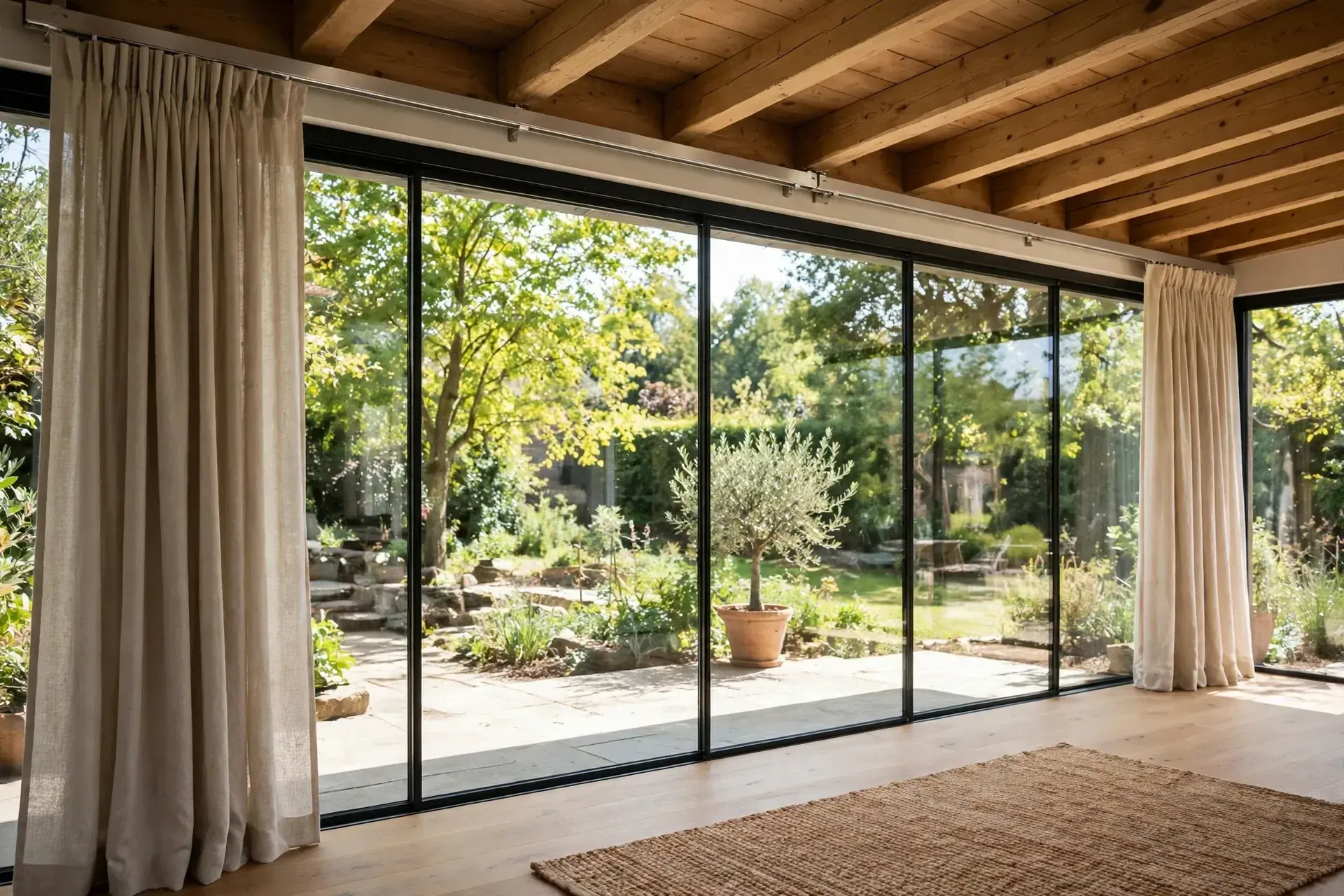
A bendable track follows the corner in one continuous run, so the curtain glides around the bend without a gap, while two straight rods meeting at a corner leave a gap where light and eyes get in. A bay-style sunroom with angled walls needs the same answer: a bendable track or a jointed rod that follows the angle, with carriers that glide smoothly around the bend. An eyelet heading does not run well around a bend, so choose a wave, pencil pleat, or ripple fold heading for a bent track. Leave space at the ends of the track for the stack, because a full panel stacks wider than a sheer, and open curtains with nowhere to stack cover the glass and block the view the sunroom was built for. For the hanging steps in full, see How to Hang Curtains, and for measuring, see How to Measure for Curtains.
Heading glide matters where curtains are opened and closed often. Rings, pins, and grommets glide easily, and pinch pleat, flat panel, and eyelet headings glide smoothly on tracks, while rod pocket, tab, tie, and back-tab headings keep permanent sheers taut in wind. Tab tops add several inches to the overall length, so measure for the tab drop, and closer tab spacing gives more gathered folds. Sliding panel track curtains suit large window walls and sliding doors, on ceiling or wall tracks, where heavier fabrics slide more smoothly and the panels overlap and stack to one side or the center.
No-drill options for sunroom frames
No-drill options suit a sunroom where the frames are thin, the glass is the structure, or drilling would void a warranty, because a sunroom frame is often aluminum or uPVC rather than a solid wall, and a screw in the wrong place can crack a seal or let water in. A tension rod suits a small sunroom window set inside a frame, because it presses between the sides of the reveal and needs no holes, but it holds only a light sheer or a short cafe panel, and it will not hold a heavy lined panel. A magnetic rod suits a metal sunroom frame, because it grips the metal without a hole, but it holds only a light panel and needs a flat metal surface to grip.
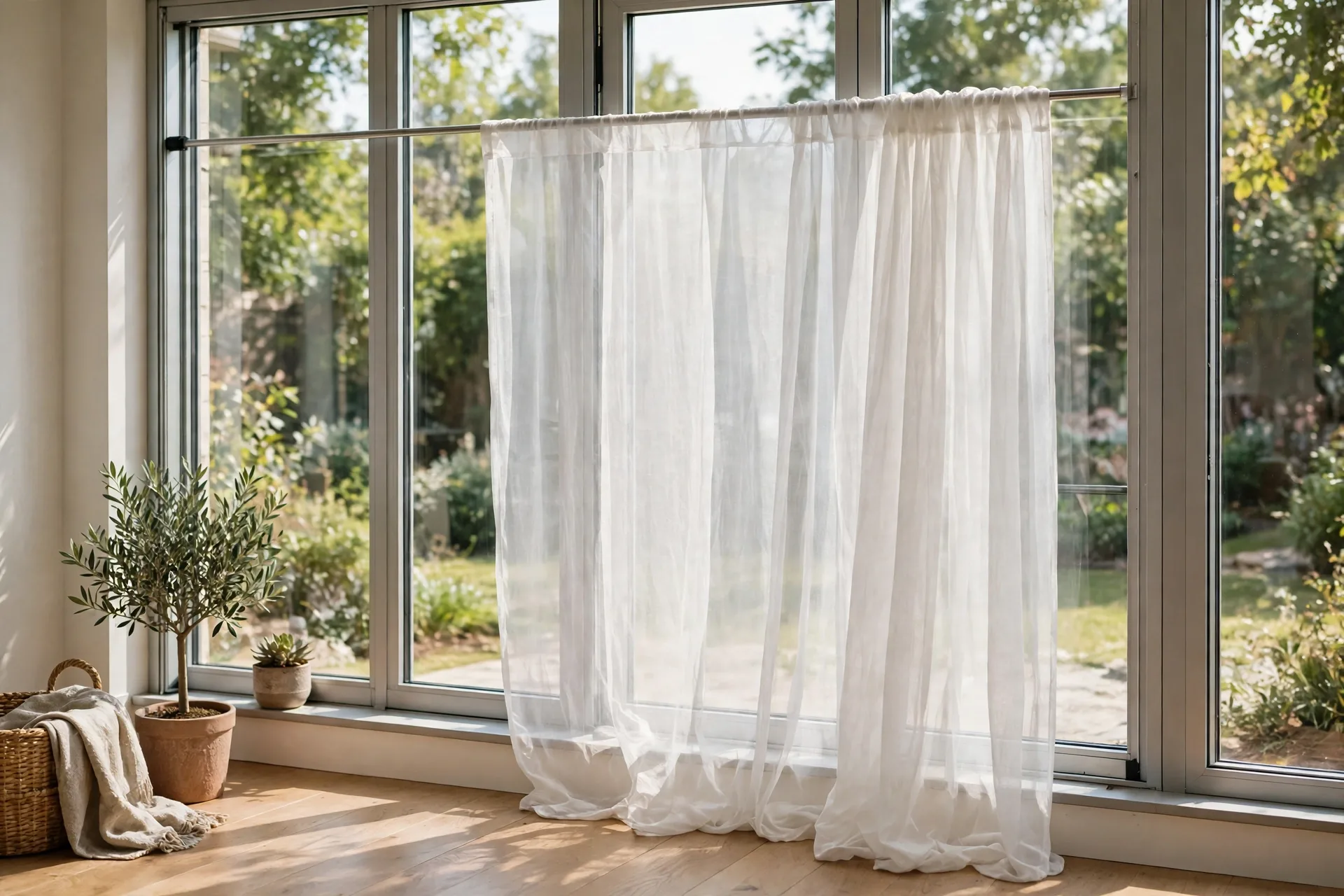
Adhesive hooks and clip-on brackets suit a light sheer on a sunroom frame, because they stick or clip without drilling, but they hold little weight and can fail in heat, which is a real risk in a sunroom where the glass warms the frame. A ceiling-mounted track fixed to the ceiling joists is the no-drill answer where the frames cannot be drilled at all, because the ceiling is usually solid even when the frames are not, and a track on the ceiling carries the full weight of a lined panel.
Gauzy cafe curtains suit a sunroom frame too: bottom-half panels on a tension rod, with ruffled, scalloped, or embroidered edges, and the top left bare or finished with a valance.
Using a sunroom through the seasons
A sunroom changes with the seasons more than any other room, because it follows the sun and the outside temperature, and the curtains should change with it. In summer the job is heat and glare: close the thermal or lined panels on the sunniest wall in the afternoon, leave the sheer closed on the other walls for soft light, and open the panels in the evening when the sun drops. Ventilate the room where you can, because a closed sunroom with closed curtains traps heat. In winter the job is cold and early darkness: close the thermal-lined panels in the late afternoon to hold the day's warmth in, and open them in the morning to let the low winter sun warm the room.
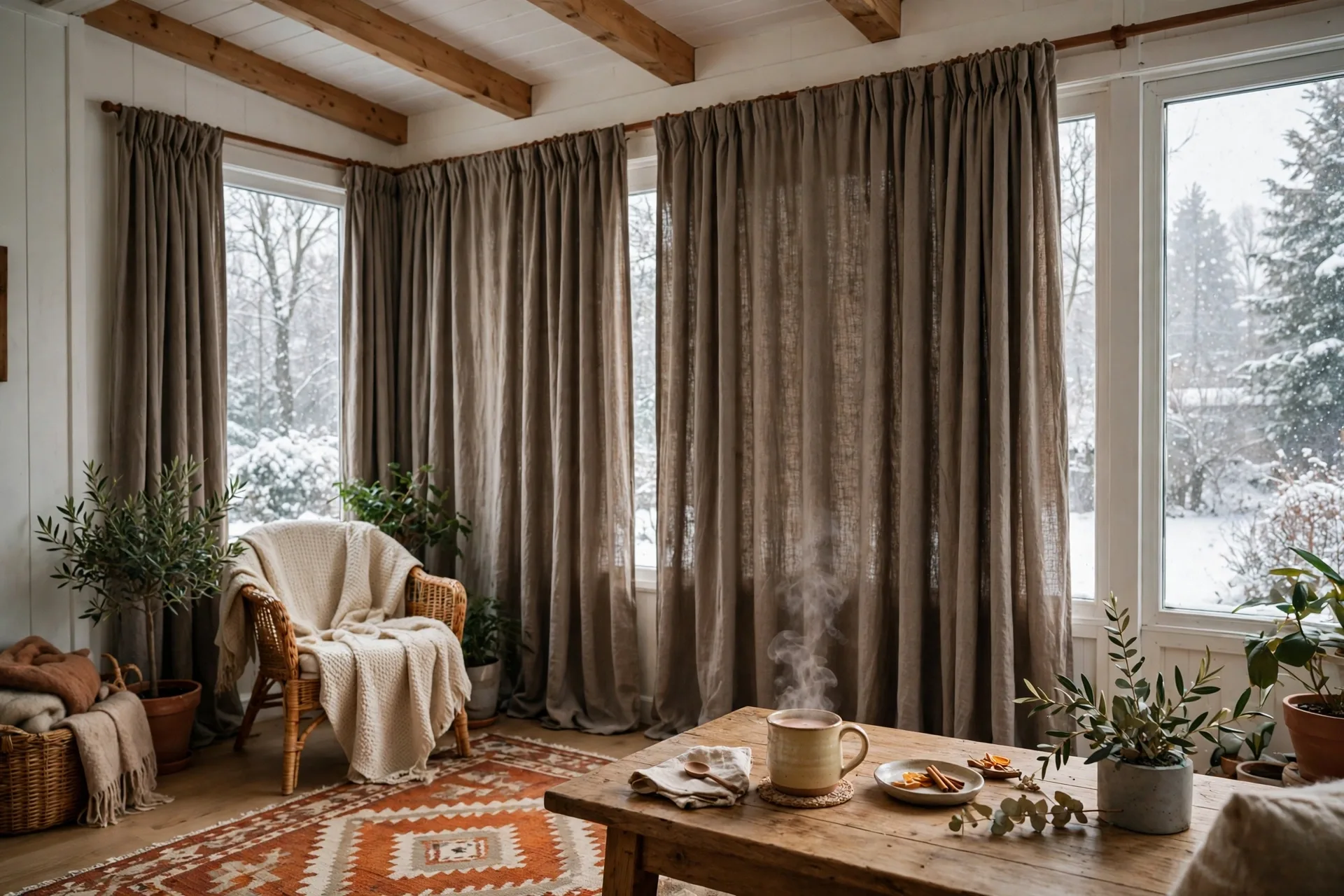
Check the curtains for condensation in winter, because warm room air meeting cold glass leaves moisture, and a curtain that stays damp will mark. In spring and autumn the sunroom is at its best: use the sheer layer alone, because it softens the light without blocking the view, and draw the lined panels fully open so the room feels like part of the garden.
Fabric follows climate too: heavier fabrics suit cold regions, and lighter fabrics suit warm regions. A small sunroom needs less bulk: Roman shades plus cafe curtains carry less bulk than full panels, short curtains brushing the sill or a few inches below keep the wall clear, tab or tie tops suit the small scale, and easy maintenance matters where kids or pets use the room. Length is best floor-to-ceiling, floating 1 in short of the floor, and never puddled in a sunroom, because the curtains are operated often and need easy motion. Tiebacks and holdbacks sit at about two thirds down, and swag styling arranges the fabric into graceful curves on the holdbacks: release the curtains fully for winter coziness, and hold them back wide for maximum summer views.
Conservatory curtains: angled glass, roof drapes, and bendable tracks
A conservatory is a sunroom with more glass, and its curtains need different answers, because the glass runs up angled walls and across the roof, not just around flat walls. The first difference is the angle: a conservatory's walls slope inward as they rise, and its roof is glass, so a straight rod hung on a flat wall does not fit, and a curtain hung from a straight rod will hang away from the glass and leave a gap. The answer is a bendable track that follows the angle of the wall, shaped on site to mirror the pitch, with carriers that glide smoothly from the vertical wall onto the slope.

Roof drapes are the second difference. A conservatory roof lets in sun from above, which warms the room fastest and fades furniture quickest, and wall curtains do nothing about it. A roof drape, a fabric panel fixed across the roof glass on a track or on wires, softens the overhead sun and cuts the worst of the heat, and it can be drawn back when the roof is wanted open to the sky. Roof drapes are harder to fit and harder to reach than wall curtains, so they suit a conservatory that overheats badly rather than one that only needs shade at the walls. Where a roof drape is too much, a close-fitting blind on the roof glass does the same job in a smaller form, and the wall curtains handle the rest.
Frame mounting is the third difference. A conservatory frame is often aluminum or uPVC, thin and hollow, so a screw into the frame trim will not hold a lined panel. Fix the track into the frame's solid core where the maker allows it, or fix it to the wall above the glass, or to the ceiling, and leave space at the ends for the curtains to stack clear of the glass. A bay-style conservatory with angled walls needs a bendable track or a jointed rod, as above, with a return to the wall so the curtain closes against the frame rather than hovering beside it.
Conservatory panels run wide: made-to-measure panels can run very wide for long glazing, so check the maker's maximum before ordering, and a joining seam appears above about 122 cm, or above about 50 cm for pinch pleats, with patterns matched across the seam. Where the room is small or furniture sits tight to the glass, Roman blinds suit better than curtains, or short curtains stopping above the furniture. Sloped glass is measured along the slope, not vertically, and most roof-window pitches run 30 to 60 degrees. Anchors must go into wood, rafters or battens behind the drywall, especially for lined fabric weight, with a bracket every 40 to 50 cm, and face-fix to the wood above the window, not the reveal. Side channels block the edge light gaps on sloped glass, and blackout lining is essential in a bedroom because sloped glass catches early morning sun earlier than a vertical window. Keep hems level with the floor or horizontal, not parallel to the sloped sill, and leave a small gap between the bottom of the covering and the sill or floor where surfaces run damp or warm. Roman blinds on slopes need a headrail at the top of the recess running down the slope, tensioned or side-guided if steeper than about 45 degrees, or the fabric bows away and the folds drop unevenly. Wider than about 1.5 m, split the blind into two narrower blinds, and a chain or wand is easier to reach than a central cord, with a motorized headrail where the blind is out of reach. On a bendable track, pencil pleat and wave headings run best on a curved or angled track, eyelets do not run well around a bend, and leave a slight overlap at the meeting point with a return to the wall. Attic and low rooms layer differently: a close-fitting thermal blind plus curtains on the vertical walls or dormers, with linen as the workhorse, because it drapes softly, filters harsh daylight, and looks better slightly rumpled, teamed with heavier wool or velvet for the coldest months, and no puddling in a low room, because it shortens the room visually and gathers dust. A small vertical window or a cushion in the same curtain fabric ties a sloped-window scheme together.
Sunroom curtain mistakes that fight the sun instead of using it
The most common sunroom mistake is choosing a dark color for a room that needs light, which absorbs heat, fades fastest, and makes the brightest room in the house feel dark. The second is buying a sheer alone for a sunroom used in the evening, which gives no night privacy once indoor lights are on. The third is hanging a straight rod across a corner and leaving a gap where light and eyes get in, when a bendable track would have followed the corner. The fourth is fixing a heavy lined panel to a thin frame that cannot hold it, which pulls out and can damage the seal. Each of these is avoidable at the ordering stage, which is why the job, the layer, the track, and the mounting all come before the color is chosen.
Frequently asked questions about sunroom curtains
Most sunroom questions come down to heat, fading, and the glass itself.
What curtains are best for a sunroom?
Sheer linen or light-filtering lined panels suit most sunrooms, because they soften harsh sunlight without losing the view or the airy feeling. A thermal lining suits a sunroom that overheats in summer or chills in winter, and a blackout panel suits a sunroom used for television or guest sleep. Choose the layer by how the room is used, because a desk, a television, a dining table, and a guest bed each need a different light job.
Do sunroom curtains stop the room overheating?
Sunroom curtains help with overheating, because a thermal lining and a light-colored face reflect heat at the glass, but they do not cool the room the way shade outside the glass would. Close the lined panels on the sunniest wall in the afternoon, ventilate the room, and treat the curtains as help rather than air conditioning. A sheer alone does little against heat.
Will sunroom curtains fade?
Sunroom curtains fade faster than curtains in any other room, because the glass lets in strong sun all day. Solution-dyed and UV-resistant fabrics hold color longest, polyester holds color better than linen or cotton, and a lining behind the face fabric takes the sun instead of the face. Light colors fade less visibly than dark colors, and rotating panels where one wall gets more sun than the other slows uneven fading.
What is the best curtain color for a sunroom?
White, cream, pale gray, and soft pastels suit a sunroom best, because they reflect sunlight and heat and keep the room feeling bright and airy. A light color on the face of a lined panel gives brightness while the lining does the light and heat work behind it.
Do I need a track or a rod for a sunroom?
A ceiling-mounted track suits a sunroom best where the glass runs to the ceiling, because it fixes to the ceiling rather than a thin frame and runs the full length of the glass wall. A bendable track suits glass walls that run around corners or angled conservatory walls, because it follows the bend in one continuous run. A rod suits a sunroom only where a solid wall sits above the glass to fix it to.
Can sunroom curtains be no-drill?
No-drill options suit a light sheer on a sunroom frame, through a tension rod inside the reveal, a magnetic rod on a metal frame, or adhesive hooks for a light panel, but none of these holds a heavy lined panel. A ceiling-mounted track fixed to the ceiling joists is the no-drill answer where the frames cannot be drilled at all, because the ceiling is usually solid even when the frames are not.
How do I keep a sunroom private at night?
A sheer alone gives almost no privacy at night once indoor lights are on, because the lit room shows through to anyone outside. Pair the sheer day layer with a lined or blackout panel that closes fully at night, on a double rod or track, unless the layers are sewn together on one rod, as in pick 5, in which case they move as one, so the room has soft light by day and full privacy after dark. Test the privacy at night by standing outside with the lights on.
For the curtains themselves, see Best Window Curtains.
This guide is research-based curation: we compared maker specifications, published reviews, and current prices. Read how we choose.